
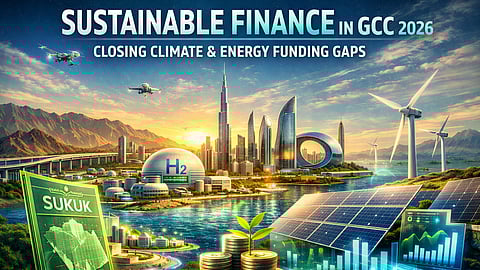
Sustainable Finance in GCC 2026: Closing Climate & Energy Funding Gaps

As the Gulf Cooperation Council (GCC) nations enter 2026, sustainable finance is no longer a niche ESG talking point—it is the engine powering economic resilience amid intensifying climate pressures and the urgent pivot away from hydrocarbon dependence.
With Middle East sustainable bond issuance projected to reach $20–25 billion this year—driven largely by record sustainable sukuk volumes—the region is defying global market slowdowns and positioning itself as a global leader in climate-aligned capital deployment.
This surge builds directly on national visions: Saudi Arabia’s Vision 2030 and Saudi Green Initiative (SGI), the UAE’s Net Zero by 2050 strategy, and parallel frameworks across Qatar, Oman, Bahrain, and Kuwait. Banks, sovereign wealth funds (SWFs), and corporates are channeling trillions in potential capital into adaptation projects—particularly water security and resilient infrastructure—while scaling renewables to meet ambitious diversification targets.
The result? Measurable returns on investment (ROI) through cost savings, job creation, emission reductions, and enhanced investor confidence.
The Funding Imperative: Closing Gaps in Adaptation and Diversification
The GCC faces acute climate vulnerabilities despite its wealth. Extreme heat, water scarcity, and rising sea levels threaten infrastructure, agriculture, and coastal cities. Globally, adaptation finance needs in developing countries are estimated at $310 billion annually by 2035—12–14 times current flows—yet the GCC’s high-income status allows it to self-fund much of this through domestic mechanisms.
Water security stands out as the flagship adaptation priority. Desalination dominates supply but is energy-intensive; the region is shifting toward circular models like wastewater reuse and nature-based solutions. Energy diversification is equally critical: Saudi Arabia targets 50% renewable electricity by 2030 under SGI, while the UAE leverages its Masdar ecosystem for solar, wind, and green hydrogen.
The funding gap here is closing rapidly through innovative instruments that align Sharia-compliant sukuk with international green bond principles.
Policy Enablers Unlocking Capital Flows
Robust regulatory frameworks are the bedrock. Saudi Arabia’s 2024 Green Financing Framework aligns with ICMA Green Bond Principles and supports SGI goals of cutting 278 million tonnes of CO₂ equivalent annually by 2030.
The Kingdom’s debut sovereign green bond (EUR 1.5 billion in 2025) and Public Investment Fund (PIF) issuances have set benchmarks. The UAE’s Net Zero 2050 Strategy and Federal Decree Law No. 11 (2024) mandate GHG reporting by 2026, while Oman’s 2024 Sustainable Finance Framework and Qatar’s central bank initiatives add momentum.
New Capital Markets Authority guidelines in Saudi Arabia (2025) and ICMA sukuk guidance have enhanced transparency, reducing greenwashing risks and attracting international investors. Blue bonds—funding sustainable water and marine projects—are emerging, with the UAE leading via instruments tied to its Water Agenda 2036.
Market Trends: Sukuk Surge and Issuance Momentum
Sustainable sukuk issuance hit a record $11.4 billion in 2025 (up from $7.9 billion in 2024), now comprising over 45% of regional sustainable bond volumes. Saudi Arabia and the UAE accounted for 80% of 2025 activity, with expectations of sustained growth into 2026. This Islamic-finance innovation perfectly suits GCC markets, blending ethical principles with use-of-proceeds for renewables, energy efficiency, and adaptation.
Transition finance is also rising, supporting hydrocarbon emitters’ decarbonization (e.g., methane abatement). Banks like First Abu Dhabi Bank (FAB) and Emirates NBD have pioneered blue and sustainability-linked issuances, while corporates tap dual-tranche deals.
Key Players: Banks, SWFs, and Corporates in Action
Sovereign Wealth Funds lead deployment. PIF is developing 70% of Saudi Arabia’s 2030 renewable target, with over $9 billion in green bond proceeds allocated to eight projects via ACWA Power and Badeel—delivering 427 MW of renewables, avoiding 5.1 million tonnes of CO₂, and treating 4 million cubic meters of wastewater. Mubadala (UAE) backs Masdar’s global renewable portfolio, including wind farms and clean hydrogen, while integrating climate criteria across investments.
Banks provide retail and corporate muscle. Saudi National Bank’s $750 million debut sustainable sukuk and regional lenders’ frameworks integrate ESG risk into lending, mobilizing private capital.
Corporates execute at scale. Masdar and ACWA Power deliver utility-scale solar/wind; Aramco and ADNOC diversify into blue ammonia and carbon capture. NEOM’s green hydrogen project—powered by solar, wind, and storage—exemplifies mega-scale diversification launching in 2026.
Adaptation in Focus: Water Security and Resilient Infrastructure
Adaptation projects are gaining traction through blended finance and PPPs. Saudi’s SWPC has scaled desalination via transparent tenders, achieving record-low tariffs with renewable integration. UAE’s TAQA Water Solutions’ Al Wathba Wetland project showcases circular reuse, biodiversity gains, and net-zero alignment. Blue bonds finance wetland conservation, coral reefs, and wastewater management—directly addressing water stress while generating stable, long-duration returns attractive to SWFs and pension funds.
These initiatives deliver clear ROI: reduced energy costs for desalination, avoided flood/drought damages, and enhanced food security. Digital tools (IoT, AI leak detection) further modernize infrastructure, lowering operational expenses by up to 20–30% in pilot programs.
Energy Diversification: Renewables Scaling with Proven Returns
Renewables are the diversification success story. Saudi has connected gigawatts of solar/wind capacity, with 63.8 GW tendered by 2030. PIF-backed projects demonstrate tangible metrics: emission avoidance, job creation (hundreds of thousands projected across the value chain), and GDP multipliers estimated at $2 trillion regionally from green investments by 2030.
Long-term power purchase agreements ensure predictable cash flows, while falling solar costs deliver competitive ROI versus traditional fuels.
Challenges and the Road to 2026
Standardization remains a hurdle—fragmented taxonomies and data gaps persist—but the proposed GCC Common Sustainable Finance Framework promises harmonization. Adaptation still lags mitigation in global flows, yet GCC innovation in blended finance and sukuk is bridging this domestically. Greenwashing risks are mitigated by ICMA-aligned disclosures.
2026 Outlook: A Green Finance Hub Emerges
2026 will see sustainable sukuk maintain momentum, blue/transition bonds expand, and private capital crowd in via de-risked pipelines. With global sustainable bond issuance stabilizing at $800–900 billion, the GCC’s $20–25 billion contribution cements its role as a growth frontier. NEOM’s hydrogen milestone, expanded Masdar projects, and water-resilience PPPs will showcase scalable, investable models.
The GCC is proving that sustainable finance is not just about compliance or reputation—it delivers resilient economies, environmental stewardship, and competitive advantage. By bridging the adaptation and diversification funding gaps today, the region is securing prosperity for generations. As issuance records tumble and projects come online, 2026 marks not the peak, but the acceleration of a truly sustainable Gulf future.
