
World’s First Hydrogen-Fuelled Main Engine Operation Marks Breakthrough for Shipping Industry
In a major step toward decarbonising maritime transport, Japan Engine Corporation (J ENG) and Kawasaki Heavy Industries have successfully conducted the world’s first factory operation of a hydrogen-fuelled main engine designed for a large commercial vessel.
The milestone comes under the Green Innovation Fund project led by New Energy and Industrial Technology Development Organization (NEDO), in collaboration with key industry players including Mitsui O.S.K. Lines (MOL), MOL Drybulk, Onomichi Dockyard, and Nippon Kaiji Kyokai.
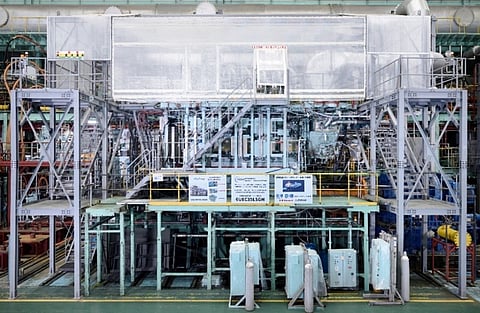
At the centre of the breakthrough is the 6UEC35LSGH engine—a fully Japan-developed, low-speed, two-stroke hydrogen engine—now operating with hydrogen co-firing across all cylinders. The system has already achieved over 95% hydrogen usage at full load, demonstrating both stable performance and significant greenhouse gas reduction potential.
While hydrogen-powered vessels have been tested globally, most projects have been limited to small-scale, short-distance applications such as tugboats and coastal vessels. This initiative, however, aims to power large oceangoing ships using liquefied hydrogen—unlocking long-distance, high-output operations and setting a new benchmark for the industry.
The engine is slated for installation in a 17,500 DWT hydrogen-fuelled multi-purpose vessel, currently under construction by Onomichi Dockyard. Alongside it, Kawasaki is developing a dedicated hydrogen fuel supply system (MHFS), which will also be integrated into the vessel.
The project is progressing steadily, with vessel design finalised and construction agreements in place. Once delivered—expected in January 2027—the ship will undergo a three-year demonstration phase from FY2028, operated by MOL and MOL Drybulk. Safety assessments throughout the lifecycle will be conducted by ClassNK.
Backed by NEDO, the collaboration marks a critical leap toward commercialising hydrogen-powered shipping, positioning the maritime sector closer to a sustainable, zero-emission future.
