
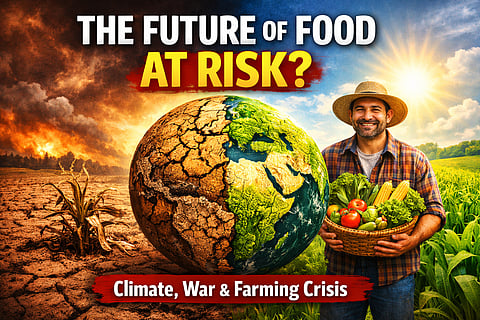
Feeding the Future: Why Agriculture and Food Security Must Be Reimagined Now

Agriculture has always been the backbone of human survival, yet today the global food system faces unprecedented stress. Climate change, geopolitical tensions, shrinking arable land, and water scarcity are converging to threaten food security across continents.
Events such as the Russia–Ukraine War disrupted global grain supply chains, exposing how dependent many nations are on a handful of agricultural exporters. Ukraine and Russia together accounted for a major share of global wheat and sunflower oil exports before the conflict, and the war sent shockwaves through food markets worldwide.
For millions of people in developing nations, food security is no longer just a development challenge—it is becoming a survival issue.
Climate Change Is Reshaping Agriculture
The greatest long-term threat to agriculture is climate instability. Rising temperatures, erratic rainfall, prolonged droughts, and floods are reducing crop yields and making farming unpredictable.
Scientific assessments by the Intergovernmental Panel on Climate Change suggest that global crop productivity could decline significantly if warming exceeds critical thresholds. Staple crops such as wheat, rice, and maize are particularly vulnerable to heat stress.
Farmers are already adapting—switching crop varieties, adopting climate-smart practices, and investing in irrigation—but adaptation alone may not be enough without systemic transformation.
The Hidden Crisis: Soil, Water, and Biodiversity Loss
Food security debates often focus on production volumes, but the real crisis lies beneath the surface—literally.
Soil degradation, declining groundwater levels, and biodiversity loss are eroding the foundation of agriculture. According to the Food and Agriculture Organization, nearly one-third of the world’s soils are already degraded due to overuse, deforestation, and unsustainable farming practices.
Monoculture farming and excessive chemical inputs have boosted short-term productivity but weakened ecosystems that sustain agriculture in the long run.
Regenerative farming, crop diversification, and agroforestry are increasingly seen as solutions that can restore soil health while improving yields over time.
Technology: A Powerful but Uneven Solution
Agricultural technology—from satellite monitoring to AI-driven precision farming—is transforming the sector. Data-driven irrigation systems, drought-resistant seeds, and digital supply chains are improving efficiency and reducing waste.
However, the benefits of agricultural innovation remain unevenly distributed. Large commercial farms often adopt new technologies faster, while smallholder farmers—who produce a significant share of the world’s food—struggle with limited access to finance, knowledge, and infrastructure.
Bridging this technology gap is essential to building a resilient global food system.
Food Waste: The Silent Contributor to Food Insecurity
Ironically, the world produces enough food to feed everyone, yet nearly one-third of it is lost or wasted each year. Post-harvest losses in developing countries occur due to poor storage, weak supply chains, and inadequate transportation infrastructure.
Reducing food waste could significantly improve global food availability without increasing production pressure on land and water resources.
India and the Food Security Challenge
Countries like India illustrate both the progress and challenges in agricultural resilience. India has transformed itself into a major agricultural producer since the Green Revolution, but new pressures are emerging.
Water-intensive crops, rising fertilizer use, and climate variability are forcing policymakers to rethink agricultural strategies. Diversification, sustainable irrigation, and farmer income stability are becoming central to the next phase of agricultural reform.
Rethinking Food Security for a Changing World
Food security can no longer be measured simply by the quantity of food produced. It must encompass sustainability, nutrition, resilience, and equitable access.
The future of agriculture will depend on a combination of smarter policies, climate-resilient farming, technological innovation, and global cooperation. If the world fails to adapt its food systems to emerging challenges, the risk of food crises could become more frequent and more severe.
But if nations invest wisely in sustainable agriculture today, the global food system can evolve from one that merely feeds the planet to one that nourishes it sustainably for generations to come.
