
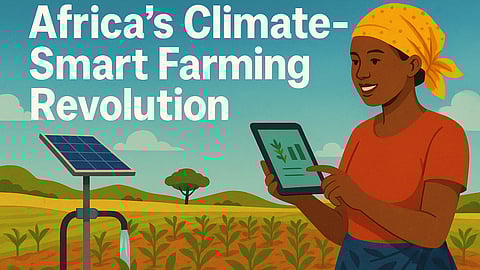
Rebuilding Food Security: The New Wave of Climate-Smart Agriculture Sweeping Across Africa

Across Africa, a quiet transformation is under way: farmers, NGOs, researchers and startups are combining old knowledge and new tools to make agriculture both more productive and more climate resilient.
From drought-tolerant seed varieties to solar irrigation pumps, and from soil-restoring regenerative practices to AI chatbots on WhatsApp, climate-smart agriculture (CSA) is moving beyond pilots into scale — and with it comes both opportunity and hard lessons about finance, governance and equity.
Why it matters now
Sub-Saharan Africa faces rising temperatures, more frequent droughts and shifting rainfall windows.
UAE Unveils Global AI Ecosystem to Transform Climate-Exposed Agriculture
That combination threatens staple yields, rural incomes and urban food prices — so solutions that simultaneously increase productivity, strengthen resilience and reduce emissions are no longer optional.
Programs across the continent are beginning to reach millions: a recent CGIAR-backed climate program reported reaching approximately 1.8 million smallholder farmers with CSA tools and services in 2024.
Drought-tolerant crops: plant breeding meets farmers’ reality
One of the most tangible wins has been the adoption of drought-tolerant varieties — especially of maize, a staple across much of Africa. Research-driven breeding programs have produced maize lines that flower and set grain more reliably under water stress, delivering yield uplifts where traditional varieties fail.
These gains matter because seed is scalable: once a variety is proven and seed systems are developed, millions of farmers can benefit within a few seasons. But to translate genetic gains into food on the table requires functioning seed certification, affordable distribution and farmer training so varieties are matched to local soils and cropping systems.
Precision irrigation and solar pumps: water where and when it’s needed
Water management is central to CSA. Precision approaches — small solar pumps, drip irrigation kits, and farm-level scheduling informed by weather forecasts — let smallholders stretch scarce water through the dry season and protect crops during short droughts.
Private companies such as SunCulture and others scaling solar irrigation have helped smallholders transition from rain-dependence to year-round cropping, increasing incomes and lowering the risk of total crop loss. The combination of lower-cost solar hardware and pay-as-you-go finance is what makes this transition achievable at scale.
Regenerative agriculture: rebuilding soils and resilience
Regenerative practices — cover cropping, agroforestry, reduced tillage, composting and integrated crop-livestock systems — regenerate soil organic matter and increase water-holding capacity.
Projects in eastern Africa show measurable soil recovery and income gains when these techniques are taught through village peer networks and supported with market linkages. For example, multi-year regenerative programs in Kenya have trained tens of thousands of farmers, improving soil health while increasing food security and diversifying incomes.
Scaling regenerative methods requires long time horizons, extension capacity and mechanisms to reward farmers for ecosystem services (carbon or watershed payment schemes).
Digital tools and agritech: closing the information gap
Mobile apps, chatbots and digital marketplaces are lowering the information barrier that has long held back smallholders. AI-driven chatbots accessible over WhatsApp are now providing localized agronomic advice in local languages, and platforms connect farmers to inputs, mechanization and finance.
Innovations that work at the last mile — for example, localized advisory in multiple languages, image-based pest diagnosis, and crop insurance that pays out after satellite-verified losses — are particularly transformative because they align technical advice with tangible services.
One such example is an AI chatbot adopted by over 100,000 farmers that provides regenerative-farming guidance in local languages.
What’s enabling scale — and what still blocks progress
Enablers: better seeds and solar hardware, cheaper sensors and mobile networks, growth in impact investors and blended finance, plus strengthened country strategies that integrate CSA into national plans.
The presence of coordinated research platforms (e.g., CGIAR networks) and technical partners accelerates evidence generation and seed multiplication.
Barriers: fragmented input markets, weak rural finance, thin insurance markets, land tenure insecurity, and limited extension reach. Equally important is the governance gap: scaling CSA requires policy support (seed law reform, subsidies targeted to smallholders, regulation for carbon-credit flows) and social safeguards so women and youth actually access the technologies.
Practical lessons from successful pilots
Fit tech to people, not the reverse. Solar pumps and precision tools work best with pay-as-you-go or leasing models that match farmers’ cashflow.
Pair technology with training and markets. Seed or a drip kit alone rarely changes livelihoods unless farmers also gain market access and agronomic know-how.
Use digital tools to amplify extension. Local-language chatbots, SMS advisories and simple dashboards let extension agents support many more farmers at low marginal cost.
Measure long-term soil and water benefits. Short project cycles undercount gains from soil building and agroforestry — financing models must reflect multi-year returns.
Policy and investment priorities to accelerate impact
• Strengthen national seed systems and fast-track registration for proven climate-smart varieties.
• Expand blended finance for smallholders — linking micro-credit, input bundles and off-taker contracts to reduce risk.
• Support digital public goods (localized weather data, open soil maps) to lower costs for private innovators.
• Develop safeguards and inclusion metrics so women, young farmers and marginalized groups benefit equitably.
A cautious optimism
The evidence is clear: when agriculture integrates climate-resilient genetics, smarter water use, soil restoration and accessible digital advisory, smallholder productivity and resilience improve. The challenge now is not only technical — it is political and financial: building systems that make these gains durable, inclusive and widely affordable.
If governments, donors and the private sector align incentives and invest in the long horizon that soil and seed demand, Africa’s farmers can turn climate risk into an opportunity for a more productive and sustainable food future.
Read More: Insight: Probiotics and Prebiotics - Powering Sustainable Food Systems
