
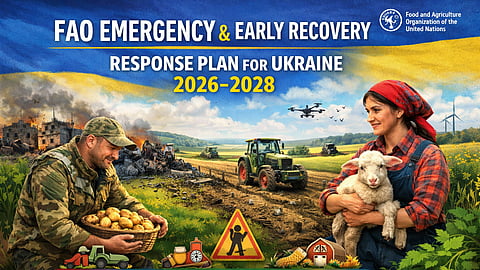
Ukraine’s Agriculture: FAO Unveils Three-Year Emergency and Early Recovery Plan
The war has profoundly impacted Ukraine's agricultural sector, complicating access to land, machinery, and markets. Frontline regions face severe damage to infrastructure, explosive remnants restricting farmland, labor shortages, and soaring costs.
These issues have disrupted production, limited market access, and pushed many farmers into survival mode, threatening food security, employment, and economic stability.
A Comprehensive Response Plan
The Food and Agriculture Organization of the United Nations (FAO) has launched its Emergency and Early Recovery Response Plan for Ukraine 2026–2028. This integrated approach combines immediate aid with resilience-building measures to safeguard food production for vulnerable rural families and small-scale farmers. It focuses on restoring productive assets, rehabilitating contaminated land, and promoting market-oriented, climate-resilient farming.
“The war has significantly complicated the lives of Ukrainian farmers... This is why we are investing in the resilience of rural families and the future of Ukraine’s food systems.” — Taras Vysotskyi, Deputy Minister of Economy, Environment and Agriculture of Ukraine
Three Pillars of Action
The plan is built on three interconnected pillars to ensure targeted, data-driven support aligned with national priorities:
Evidence and Coordination: Strengthening data systems and partnerships for effective response.
Emergency Agriculture: Providing urgent assistance like seeds, feed, and cash to maintain livelihoods.
Early Recovery: Rehabilitating land, infrastructure, and supply chains for sustainable rebuilding.
Special priority is given to frontline areas, women, youth, internally displaced persons, and returnees. A key focus is demining agricultural land—essential for safe farming and economic revival.
“Ukraine’s rural communities cannot afford a pause between emergency response and recovery. This Plan is designed to bridge that gap.” — Shakhnoza Muminova, Head of FAO in Ukraine
Targeting Support and Scaling Impact
FAO aims to assist over 239,000 rural families and small-scale farmers (reaching more than 500,000 vulnerable people) through the plan, which requires USD 150 million in funding. Current FAO projects in Ukraine total USD 25.9 million, with USD 24 million already dedicated to emergency efforts. Additional resources will prevent further losses and support long-term development.
FAO’s Track Record in Ukraine
Since the war escalated in 2022:
Supported over 300,000 rural families and nearly 17,000 small-scale agrifood enterprises.
Delivered seeds, animal feed, poultry kits, grain storage, generators, irrigation systems, cash, vouchers, and grants.
Analyzed 2.37 million hectares via satellite, identifying over 1 million craters.
Prioritized 32,000 hectares for mine clearance; farmers on over 22,000 hectares have resumed activities.
Looking Ahead
The 2026–2028 plan provides a clear roadmap to scale up these efforts amid persistent needs. By linking humanitarian aid with recovery investments, FAO is helping preserve Ukraine’s agricultural potential—a vital pillar of national resilience, food security, and future reconstruction. Continued international support is essential to turn this vision into reality.
