
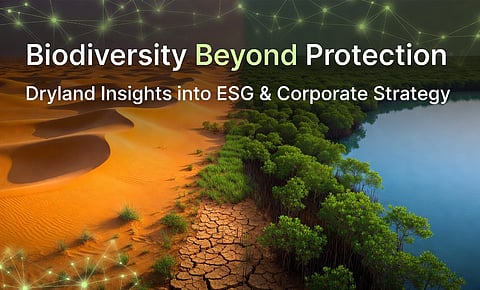
Biodiversity to Business: ESG Strategies for Middle East Drylands

In December 2024, Riyadh hosted the largest UNCCD COP16 ever, drawing over 20,000 participants and marking the first time this landmark land conference convened in the Middle East—the region most intimately acquainted with the realities of desertification and drought.
The timing was symbolic: drylands now blanket 40.6% of global land (excluding Antarctica), up significantly in recent decades, while 77.6% of Earth’s terrestrial surface has become permanently drier over the past three decades. Some 2.3 billion people—nearly one-third of humanity—now inhabit these expanding arid zones, with projections warning of up to 5 billion by 2100 under high-emissions scenarios.
For Middle East businesses, this is not abstract environmental data—it is operational reality. From Saudi Arabia’s vast Rub’ al-Khali to the UAE’s coastal sabkhas, dryland ecosystems underpin economies built on energy, agriculture, real estate, tourism, and finance. Yet traditional “protection-only” approaches—fencing off reserves or offsetting impacts—are insufficient in a region where aridity is accelerating.
The new imperative: translate deep ecological insights from these hyper-adapted systems into proactive ESG integration and corporate strategy. As UNCCD COP16 President noted, “This session marks a turning point,” signaling a shift toward private-sector-led restoration, sustainable finance, and ESG-driven land stewardship.
Middle Eastern leaders are already responding. Eighty percent of regional business executives report having formal sustainability strategies, per PwC research, yet employee priorities and execution gaps remain. The opportunity lies in moving beyond compliance to innovation—leveraging dryland biodiversity for drought-resistant technologies, nature-based solutions, and resilient value chains that enhance ESG ratings, attract capital, and future-proof operations.
The Dryland Reality: Unique Biodiversity Under Threat
Drylands are far from barren. They harbor extraordinary biodiversity: drought-tolerant flora like Acacia and Haloxylon species that stabilize soils and sequester carbon; microbial communities in hyper-arid soils that drive nutrient cycling; and fauna adapted to extreme temperatures and water scarcity. In the Middle East, these systems support traditional livelihoods, coastal mangroves that act as carbon sinks and nurseries for marine life, and rangelands that sustain pastoral economies.
However, accelerating aridity—driven by climate change and human pressures—threatens this web. The UNCCD’s Global Threat of Drying Lands report (launched at COP16) documents cascading impacts: land degradation affecting 40% of arable land globally, biodiversity declines, intensified sand and dust storms, and migration risks.
In the MENA region, urbanization, overgrazing, and water scarcity exacerbate these trends, with projections of further dryland expansion across the Mediterranean basin and Arabian Peninsula.
Yet herein lies the insight: dryland species embody resilience. Their physiological adaptations—efficient water-use efficiency, deep root systems, and symbiotic microbiomes—offer blueprints for corporate adaptation in a hotter, drier world.
Ecological Wisdom from the Desert: Lessons for Business Resilience
Dryland ecosystems teach three core principles directly translatable to corporate strategy:
Extreme Efficiency and Circularity: Desert plants like those in Saudi Arabia’s Tabuk region minimize water loss through specialized physiologies, informing precision agriculture and water stewardship models. Companies can apply these to reduce operational footprints in water-scarce supply chains.
Regenerative Restoration: Mangrove and rangeland systems demonstrate rapid recovery potential when supported by nature-based interventions. Saudi Aramco’s mangrove initiatives and UAE’s drone-assisted planting show how targeted restoration yields multi-fold returns: carbon sequestration up to five times higher than terrestrial forests, coastal protection, and biodiversity uplift.
Biomimicry and Innovation: Extremophile microbes from arid soils enable breakthroughs in biotechnology, from drought-resistant crops (via ICARDA partnerships) to novel materials and pharmaceuticals. These insights support R&D pipelines that align with ESG innovation metrics.
As the World Bank’s Biodiversity for a Livable Planet evaluation underscores, drylands and deserts receive disproportionately low conservation funding despite their ecological and carbon value—creating untapped opportunity for forward-looking businesses.
Elevating ESG: Biodiversity as a Core Strategic Pillar
ESG frameworks are evolving from climate-centric to nature-inclusive, with the Taskforce on Nature-related Financial Disclosures (TNFD) providing the roadmap. Middle East businesses can integrate dryland insights by:
Assessing Nature Dependencies and Impacts: Mapping operations against dryland vulnerabilities (e.g., water scarcity risks to energy and agribusiness) using TNFD’s LEAP approach (Locate, Evaluate, Assess, Prepare).
Achieving Biodiversity Net Gain: Embedding restoration in project design—e.g., ADNOC’s commitment to 10 million mangroves by 2030 via drone technology, which simultaneously advances environmental metrics and community benefits.
Aligning with Global Frameworks: Linking to the Kunming-Montreal Global Biodiversity Framework (GBF), UN Sustainable Development Goals (especially SDG 15), and regional initiatives like Saudi Vision 2030 and the UAE’s National Biodiversity Strategy. COP16’s Business4Land initiative explicitly calls for ESG strategies to drive private-sector investment in land restoration, noting that private finance currently covers just 6% of needs.
This integration mitigates risks (regulatory, reputational, physical) while unlocking opportunities: enhanced credit ratings, green sukuk issuance, and access to nature-positive capital flows.
Actionable Corporate Strategies: From Compliance to Leadership
Middle East firms can operationalize dryland insights through targeted playbooks:
Supply Chain Resilience: Adopt regenerative sourcing for date palms, camel products, or rangeland-derived goods, drawing on dryland ecology to build climate-proof agriculture. ICARDA’s work in Tunisia and beyond demonstrates scalable models for animal feeding and pastoral landscapes.
Innovation and Product Development: Invest in bio-inspired solutions—e.g., desert-plant genetics for sustainable cosmetics, pharmaceuticals, or arid-adapted crops—positioning firms as leaders in the growing “blue-green” economy.
Finance and Investment: Leverage green sukuk and the Riyadh Global Drought Resilience Partnership (which secured over $12 billion in pledges at COP16, including $150 million from Saudi Arabia) to fund restoration projects with verifiable ESG returns.
Stakeholder Engagement and Reporting: Collaborate via Business4Land with Indigenous and local communities, incorporating traditional knowledge. Transparent TNFD-aligned disclosures differentiate leaders in investor eyes.
Risk Management: Incorporate aridity projections into scenario planning, turning potential liabilities (e.g., dust storms impacting operations) into proactive advantages.
Middle East Trailblazers: Case Studies in Action
UAE: ADNOC and Environment Agency – Abu Dhabi’s mangrove restoration (target: 10 million trees) uses AI-guided drones for precision planting, enhancing biodiversity while supporting carbon markets. Aldar Properties’ seed-sowing projects extend these benefits to urban developments.
Saudi Arabia: Saudi Aramco’s Eastern Province mangrove program (over 30 million saplings) and the Saudi Green Initiative’s ambition to plant 10 billion trees and rehabilitate 74 million hectares exemplify scale. These efforts align corporate operations with national targets for 30% protected areas and biodiversity uplift.
Broader Ecosystem: The Middle East Green Initiative extends Saudi leadership regionally, while Qatar-based carbon standards increasingly embed biodiversity co-benefits.
These initiatives demonstrate that dryland insights yield not only environmental wins but economic multipliers—jobs, tourism, and innovation hubs.
Navigating Challenges and Pathways Forward
Barriers persist: data gaps on dryland metrics, greenwashing risks, and the need for standardized ESG frameworks in MENA (as highlighted in recent Fuzzy Delphi analyses). Political instability and migration pressures add complexity. Yet COP16’s outcomes—Business4Land, the Rio Trio synergies across UN conventions, and AI-powered Drought Observatories—provide tools for acceleration.
Opportunities abound: high ROI on restoration (USD 8 returned per USD 1 invested, per UNCCD estimates) and alignment with investor demands for nature-positive portfolios.
Conclusion: A Regenerative Future for Middle East Enterprise
The Middle East stands at a unique juncture. Its businesses, forged in arid conditions, possess the cultural and geographic proximity to lead a global shift from biodiversity protection to regeneration. By embedding dryland insights—resilience, efficiency, regeneration—into ESG and corporate strategy, they can deliver not only compliance but transformative value: resilient operations, innovative products, stronger stakeholder trust, and sustainable prosperity.
As UNCCD leaders emphasized at COP16, land is the foundation linking climate, biodiversity, and human well-being. Middle East corporations that act decisively will not only safeguard their region’s future but position themselves as global pioneers in the nature economy. The desert has long whispered lessons of survival; now is the time for businesses to listen—and to thrive.
The call is clear: move beyond protection. Turn dryland wisdom into strategy. The planet—and the balance sheet—will thank you.
