
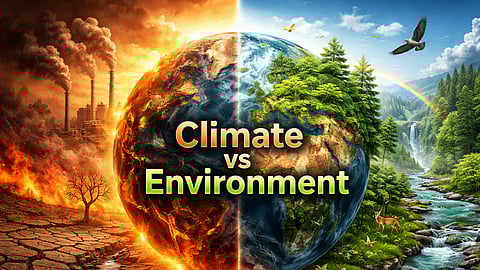
Climate vs Environment: Understanding the Difference—and Why It Matters More Than Ever

“Climate” and “environment” are often used interchangeably in public discourse, policy debates, and even media reporting. Yet, while deeply interconnected, they represent distinct concepts with different implications for how humanity understands, responds to, and plans for planetary change.
Confusing the two can dilute solutions, misdirect resources, and oversimplify some of the most complex challenges of our time. In an era of climate crises, biodiversity loss, pollution, and social inequality, clearly understanding the relationship—and the tension—between climate and environment is not just academic; it is essential for effective action.
Defining the Terms: Climate and Environment Explained
Climate refers to long-term patterns of temperature, precipitation, wind, and weather extremes over decades or centuries. It is shaped by global systems such as ocean currents, atmospheric composition, and solar radiation.
Climate change, driven largely by human-induced greenhouse gas emissions, alters these long-term patterns, leading to rising temperatures, sea-level rise, extreme weather events, and shifting ecosystems.
Environment, by contrast, is broader and more immediate. It encompasses the natural world around us—air, water, land, ecosystems, biodiversity—as well as human-made surroundings.
Environmental issues include deforestation, air and water pollution, soil degradation, plastic waste, habitat loss, and chemical contamination. While climate change affects the environment, not all environmental problems are climate problems—and vice versa.
Where Climate and Environment Intersect
The climate and environment are inseparable in practice. Climate change acts as a multiplier of environmental stress, intensifying existing problems:
Rising temperatures worsen air pollution and heat stress in cities
Changing rainfall patterns accelerate desertification and water scarcity
Ocean warming and acidification threaten coral reefs and marine biodiversity
Extreme weather events destroy habitats, forests, and agricultural systems
At the same time, environmental degradation feeds back into climate change. Deforestation reduces carbon sinks, polluted oceans absorb less carbon dioxide, and degraded soils store less organic carbon. The result is a dangerous feedback loop where environmental harm accelerates climate instability, and climate instability deepens environmental loss.
Key Differences That Shape Policy and Action
Despite their overlap, climate and environmental challenges require different approaches:
Climate action focuses heavily on mitigation (reducing emissions) and adaptation (adjusting to impacts). This includes renewable energy, carbon markets, net-zero targets, and climate-resilient infrastructure.
Environmental action often centers on conservation, regulation, restoration, and pollution control—protecting forests, cleaning rivers, preserving wildlife, and improving waste management systems.
A city may reduce its carbon emissions by switching to solar power, yet still suffer from toxic air pollution, water contamination, or biodiversity loss if environmental governance is weak. Conversely, strong conservation policies may protect forests locally but fall short if global emissions continue to rise unchecked.
The Human Dimension: Inequality at the Core
Both climate and environmental crises are deeply social. Vulnerable communities—particularly in the Global South—contribute the least to climate change yet bear the brunt of its impacts.
Environmental degradation often affects those with the fewest resources to respond: informal settlements exposed to floods, farmers facing soil depletion, coastal communities losing livelihoods to ocean pollution.
This overlap highlights a critical truth: climate justice and environmental justice are inseparable. Solutions must address not only carbon metrics or conservation targets, but also livelihoods, equity, public health, and access to resources.
Why the Distinction Matters Now
Failing to distinguish climate from environment can lead to narrow, incomplete solutions. A purely climate-focused strategy may ignore biodiversity collapse.
An environment-only approach may overlook the systemic role of fossil fuels. The future demands integrated thinking—policies that reduce emissions while restoring ecosystems, protecting communities, and building long-term resilience.
Nature-based solutions, circular economy models, regenerative agriculture, and sustainable urban planning exemplify this integrated approach. They recognize that a stable climate depends on a healthy environment—and that a healthy environment cannot survive an unstable climate.
Conclusion: One Planet, Two Lenses, Shared Responsibility
Climate and environment are not competing priorities; they are complementary lenses through which we understand Earth’s fragility and resilience.
Climate change defines the long-term conditions of our planet, while environmental health shapes the quality of life within those conditions. Addressing one without the other is no longer viable.
As the world navigates the defining challenge of the 21st century, clarity of understanding must guide clarity of action. Protecting the environment stabilizes the climate. Stabilizing the climate safeguards the environment.
Together, they form the foundation of a livable future—one where development, nature, and humanity can coexist in balance rather than conflict.
