
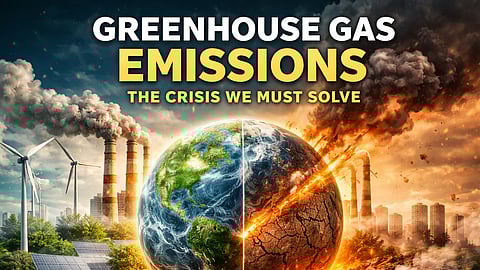
Greenhouse Gas Emissions: The Invisible Force Reshaping Our Planet

Greenhouse gas (GHG) emissions are often reduced to a single phrase—carbon pollution. In reality, they represent a complex mix of gases that trap heat in Earth’s atmosphere and fundamentally alter the planet’s climate system.
The primary greenhouse gases include carbon dioxide (CO₂), methane (CH₄), nitrous oxide (N₂O), and fluorinated gases. While carbon dioxide dominates in volume, methane and nitrous oxide are far more potent heat-trappers over shorter time horizons.
Human activity—particularly fossil fuel combustion, industrial processes, deforestation, agriculture, and waste—has dramatically increased the concentration of these gases since the Industrial Revolution.
What makes GHG emissions especially dangerous is their cumulative nature. Once released, many remain in the atmosphere for decades or even centuries, locking in warming effects long after the original source has disappeared.
The Environmental Impact: A Planet Under Stress
The most visible consequence of rising GHG emissions is global warming, but the deeper environmental impacts go far beyond rising temperatures.
Warming oceans absorb over 90% of excess heat, leading to coral bleaching, disrupted marine ecosystems, and declining fish stocks.
On land, shifting temperature and rainfall patterns are altering ecosystems faster than species can adapt. Forests face increased drought stress and wildfire risk, while polar ice melt accelerates sea-level rise, threatening coastal communities and island nations.
Extreme weather events—heatwaves, floods, droughts, and storms—are becoming more frequent and intense. These are not isolated disasters but interconnected signals of a destabilized climate system driven by unchecked emissions.
GHG Emissions and the Ozone Layer: A Complex Relationship
The ozone layer, which protects life on Earth from harmful ultraviolet (UV) radiation, is often mistakenly conflated with climate change. While ozone depletion and global warming are distinct phenomena, they are closely linked through atmospheric chemistry.
Certain greenhouse gases, particularly nitrous oxide, are now among the leading ozone-depleting substances. Meanwhile, climate change alters atmospheric circulation, influencing how ozone is formed and destroyed in the stratosphere. Warming in the lower atmosphere coupled with cooling in the upper layers can slow ozone recovery in some regions.
Although global action under the Montreal Protocol has helped repair the ozone layer, rising GHG emissions risk undermining these gains, reminding us that environmental challenges cannot be addressed in isolation.
Human, Economic, and Ecological Costs
The impacts of GHG emissions extend directly into human well-being and economic stability. Rising heat increases health risks, particularly for the elderly and outdoor workers. Air pollution linked to fossil fuel combustion worsens respiratory and cardiovascular diseases.
Economically, climate-driven disruptions threaten food security, water availability, and infrastructure. Agriculture faces unpredictable growing seasons, while energy systems struggle under extreme demand.
The cost of inaction is increasingly clear: climate-related losses already run into hundreds of billions of dollars annually, disproportionately affecting developing nations least responsible for emissions.
Resolution Pathways: From Reduction to Transformation
Reducing greenhouse gas emissions is no longer just about efficiency—it requires systemic transformation.
The energy transition sits at the core. Rapid deployment of renewable energy, electrification of transport and industry, and the phase-down of coal and other high-emission fuels are essential. Equally important is improving energy efficiency across buildings, manufacturing, and urban design.
Nature-based solutions—such as restoring forests, wetlands, and mangroves—offer powerful carbon sinks while enhancing biodiversity and climate resilience. At the same time, emerging technologies like green hydrogen, carbon capture, and sustainable fuels can help decarbonize hard-to-abate sectors.
However, technological solutions alone are insufficient without behavioral change, circular economy principles, and responsible consumption patterns.
Global Commitments: Promises Versus Progress
International frameworks such as the Paris Agreement reflect a shared recognition of the problem, with countries committing to limit global warming to well below 2°C. Yet a significant gap remains between pledges and real-world action.
Many national commitments lack clear implementation pathways, financing mechanisms, or enforcement. Meanwhile, global emissions continue to rise, driven by growing energy demand and uneven transitions. Climate finance, technology transfer, and equitable responsibility-sharing remain critical challenges, especially for emerging economies.
True commitment must be measured not by announcements, but by policies, investments, and outcomes.
Conclusion: A Defining Test for This Generation
Greenhouse gas emissions represent one of the most profound challenges humanity has ever faced—not because the solutions are unknown, but because they demand collective resolve, long-term thinking, and immediate action.
The science is clear: every fraction of a degree matters, every year counts, and every sector must contribute. Addressing GHG emissions is not only about protecting the environment; it is about safeguarding economic stability, public health, and the planet’s life-support systems.
The choices made today will determine whether future generations inherit a world of escalating crises or a resilient, balanced Earth. The window for action is still open—but it is narrowing fast.
