
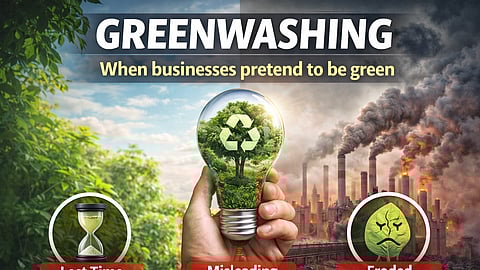
Greenwashing: When Sustainability Becomes a Marketing Illusion

As climate change, biodiversity loss and social responsibility move to the centre of public consciousness, sustainability has become one of the most powerful currencies in business. “Green”, “eco-friendly” and “net zero” now dominate corporate messaging across industries.
But alongside genuine progress, a more troubling trend has taken root: greenwashing—the practice of presenting an exaggerated, misleading or false impression of environmental responsibility.
Greenwashing is not just a branding problem. It undermines trust, distorts markets, slows real climate action and ultimately weakens the global response to environmental crises.
Why greenwashing thrives
Greenwashing flourishes in the gap between complex sustainability challenges and simple marketing narratives. Climate science, supply chains and emissions accounting are difficult to explain. Marketing, on the other hand, rewards clarity, speed and emotional appeal. When regulation is weak or fragmented, the temptation to oversimplify—or selectively disclose—becomes strong.
Many companies are also under pressure from investors, consumers and employees to demonstrate climate leadership. In the absence of affordable solutions or scalable technology, some choose optics over impact: a recycled label here, a carbon-neutral claim there, often without full-life-cycle accountability.
The most common forms of greenwashing
Greenwashing is rarely an outright lie. More often, it appears in subtle, carefully worded claims:
Vague language: Terms like “eco-friendly” or “natural” without definitions, data or benchmarks.
Selective disclosure: Highlighting a single green initiative while ignoring a company’s larger environmental footprint.
Offset overreliance: Claiming carbon neutrality based primarily on offsets rather than actual emissions reductions.
Irrelevant claims: Promoting compliance with regulations as voluntary sustainability leadership.
Visual misdirection: Nature imagery and green branding that imply environmental benefit without evidence.
These practices create an illusion of progress while masking systemic inaction.
The environmental cost of misleading claims
The greatest damage caused by greenwashing is lost time. When consumers and investors believe change is happening faster than it actually is, pressure for deeper transformation weakens. Capital flows toward companies that market sustainability well, rather than those delivering genuine emissions cuts or ecosystem protection.
This misallocation of trust and investment delays innovation, slows the scaling of clean technologies and allows high-emitting practices to persist under a green veneer.
Eroding trust in sustainability itself
Greenwashing also risks a broader credibility crisis. As exposed cases multiply, public scepticism grows—not just toward individual brands, but toward sustainability claims as a whole. This erosion of trust makes it harder for genuinely responsible companies to differentiate themselves and for policymakers to mobilise public support for ambitious climate action.
In the long run, greenwashing does not just deceive audiences; it weakens the entire sustainability ecosystem.
Regulation is catching up—but unevenly
Governments and regulators are beginning to respond. The EU’s proposed Green Claims Directive, tougher disclosure rules under CSRD, and growing scrutiny of net-zero claims reflect a shift toward accountability. Financial regulators are also tightening oversight of ESG disclosures to curb misleading reporting.
However, regulation remains uneven globally. Many markets still rely on voluntary standards, creating loopholes that allow greenwashing to persist—particularly in complex global supply chains.
The business case for real sustainability
Ironically, greenwashing often backfires. As data transparency improves and civil society scrutiny intensifies, misleading claims are increasingly exposed—damaging brand value, investor confidence and employee trust.
By contrast, companies that focus on measurable impact, transparent reporting and long-term transformation are better positioned to manage risk, attract capital and remain competitive in a low-carbon economy.
True sustainability is less about perfection and more about credible progress—clear targets, honest reporting and continuous improvement.
Moving from greenwash to green impact
Ending greenwashing requires a shift in mindset. Sustainability should not be treated as a communications exercise, but as a core business strategy. That means aligning marketing with operations, backing claims with data, and prioritising real emissions reductions over shortcuts.
For consumers, investors and policymakers, it means asking harder questions: Compared to what? Measured how? Verified by whom?
In a world running out of ecological margins, the cost of illusion is too high. The transition to a sustainable future depends not on how green we sound, but on how deeply we change.
