
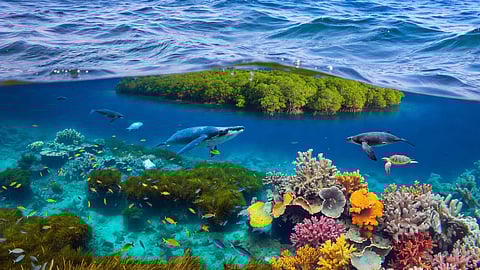
Guardians of the Blue Heart: Why Saving Marine Life Is Saving Humanity Itself

Introduction: The Ocean Is Not Too Big to Fail
For centuries, humanity treated the sea as infinite — an endless source of food, oxygen, trade routes, and wonder. Today we know better. Covering 71% of Earth’s surface and holding 97% of its water, the ocean is not invincible. It is bleeding.
Coral reefs are bleaching white, seagrass meadows are vanishing, fish nurseries are turning into dead zones, and iconic species from whales to sea turtles are sliding toward extinction.
What happens in the deep water does not stay in deep water. The destruction of marine flora and fauna is already disrupting global climate regulation, food security, coastal economies, and even the air we breathe.
Guardians of the Blue Planet: Why Our Oceans Demand Collective Action
This is not an environmental tragedy happening “somewhere else.” It is a direct, accelerating threat to human civilization.
The Living Fabric of the Ocean: Who We Are Losing
The ocean’s biodiversity is staggering:
Over 240,000 described species and possibly two million more awaiting discovery
Coral reefs — covering less than 0.1% of the seabed — host 25% of all marine life
Seagrass meadows, mangroves, and salt marshes (the “blue forests”) shelter 80–90% of commercial fish species during part of their life cycle
Phytoplankton — microscopic marine plants — produce at least 50–80% of the planet’s oxygen, every second breath we take
When we destroy these ecosystems, we are not just losing the foundations of life itself.
The Destruction: A Perfect Storm of Human Impacts
Overfishing and Destructive Fishing Practices
34% of global fish stocks are overexploited, 60% are fished at maximum capacity (FAO 2024). Bottom trawling — compared to clear-cutting rainforests — damages 3.9 million km² of seabed annually.
Climate Change and Ocean Warming
90% of excess heat from greenhouse gases is absorbed by the ocean. Coral bleaching events, once rare, now strike almost yearly. The Great Barrier Reef has lost half its corals since 1995.
Ocean Acidification
The sea has absorbed 30% of human CO₂ emissions, dropping pH by 0.1 units — a 30% increase in acidity. Shell-forming creatures (pteropods, oysters, corals) struggle to build skeletons.
Pollution Apocalypse
17 million metric tons of plastic enter the ocean every year. Microplastics are now found in 88% of ocean surface samples and inside the bodies of creatures from plankton to whales. Chemical runoff creates 500+ coastal dead zones.
Coastal Habitat Destruction
50% of mangroves, 35% of seagrass beds, and 29% of coral reefs have disappeared since the 19th century, mostly in the last 50 years.
The Domino Effect: How Marine Collapse Hits Humanity
1. Food Security Under Siege
Three billion people depend on seafood for 20% of their animal protein. The collapse of key fisheries (cod, tuna, anchovy) has already caused economic losses exceeding $100 billion annually. Small island nations and West African communities face famine risks as stocks vanish.
2. Oxygen and Climate Catastrophe
If phytoplankton populations crash — already down 40% in some regions since 1950 — we lose a major carbon sink and oxygen factory. A 2025 Nature study warned that continued warming could trigger a 15–20% drop in ocean oxygen production by 2100.
3. Coastal Protection Vanishing
Mangroves and coral reefs reduce wave energy by up to 97%. Their loss amplifies storm damage: the 2004 Indian Ocean tsunami and Hurricane Katrina would have been far less deadly with intact natural barriers. By 2050, 300 million people could face annual flooding due to reef and mangrove degradation.
4. Economic Tsunami
Ocean economies (fisheries, tourism, shipping) generate $3–6 trillion annually. Coral reef tourism alone is worth $36 billion a year. As reefs die, destinations like the Maldives, Belize, and the Great Barrier Reef face existential economic threats.
5. Medicine and Innovation Lost Forever
70% of anti-cancer compounds under trial come from marine organisms. Cone snail venom gave us ziconotide (a painkiller 1,000 times stronger than morphine). Every species driven extinct is a potential cure erased.
Rays of Hope: Solutions That Are Already Working
Marine Protected Areas (MPAs): Fully protected zones covering just 8% of the ocean have shown fish biomass increasing by 670% and species diversity by 166% within a few years.
30×30 Commitment: 110 countries have pledged to protect 30% of the ocean by 2030 under the UN High Seas Treaty (2023).
Restoration Success: Australia’s reef restoration projects have reintroduced 100 million corals. Seagrass planting in Virginia (USA) revived 9,000 acres — the world’s largest project.
Sustainable Blue Foods: Seaweed and bivalve farming have near-zero carbon footprints and can feed billions without overexploiting wild stocks.
Technology and Enforcement: Satellite monitoring, AI-powered cameras, and transparent supply chains are slashing illegal fishing by up to 90% in monitored zones.
Conclusion: The Ocean Is Us
The fate of marine flora and fauna is not a niche environmental issue — it is the frontline of human survival. Every bleached coral, every trawled seabed, every plastic-choked turtle is a warning light on the dashboard of civilization.
Yet the same species that caused this crisis has proven capable of extraordinary repair when we choose to act. Expanding protected areas, slashing emissions, ending destructive fishing, and restoring coastal ecosystems are not optional “green” policies — they are the most urgent investments in food, breathable air, and planetary stability we can make.
The ocean has sustained life for 3.8 billion years. Now, for the first time, its future depends on us. If we become its guardian instead of its destroyer, we secure our own.
The blue heart of Earth is still beating. It is time to protect it with everything we have.
Read More: Rising Tide for Ocean Action: Why Climate Plans Must Go Blue Before COP30
