
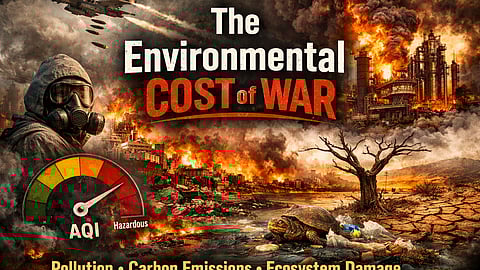
How the Ongoing Middle East Conflict Is Worsening Air Pollution, Climate Emissions, and Ecosystem Damage

The ongoing conflicts across the Middle East — particularly the war involving Israel, Gaza, Iran, and regional actors — are not only humanitarian and geopolitical crises.
They are also rapidly becoming major environmental disasters, producing massive greenhouse gas emissions, deteriorating air quality, contaminating water resources, and damaging ecosystems across the region.
From toxic smoke in cities to millions of tonnes of carbon emissions, the environmental footprint of war is growing — often with consequences that last decades.
1. War and Air Pollution: A Sharp Rise in AQI and Toxic Particulates
One of the most immediate environmental impacts of warfare is air pollution caused by explosions, fires, and burning infrastructure.
Airstrikes on fuel depots and oil facilities have recently created dense clouds of toxic smoke across several Middle Eastern cities. In Tehran, for example, massive fires triggered by strikes on oil storage facilities released soot, sulphur compounds, and heavy metals, severely degrading air quality and even causing reports of acidic rainfall.
These events release large quantities of pollutants including:
PM2.5 and PM10 particulate matter
Sulfur dioxide (SO₂)
Nitrogen oxides (NOx)
Volatile organic compounds (VOCs)
Such pollutants dramatically increase Air Quality Index (AQI) levels and trigger respiratory illnesses. In many war zones, monitoring systems collapse, meaning pollution levels may be significantly underreported.
In Gaza, satellite-based studies show clear increases in particulate matter and carbon monoxide levels during heavy bombardment periods, linking war activity directly to worsening air pollution.
Additionally, the burning of buildings releases toxic chemicals from:
plastics
electronics
asbestos
industrial chemicals
This turns war zones into temporary toxic atmospheres, endangering civilians and soldiers alike.
2. Massive Carbon Emissions: War as a Hidden Climate Polluter
War is rarely included in climate accounting, yet modern conflicts generate enormous greenhouse gas emissions.
Recent research estimates that the Israel–Gaza war alone has produced around 33 million tonnes of CO₂ equivalent emissions.
To understand the scale:
Equivalent to the annual emissions of Jordan
Equal to emissions from 7.6 million petrol cars for a year
Comparable to the carbon absorbed by over 33 million acres of forest annually
These emissions come from multiple sources:
Military operations
fighter jets
tanks
missile launches
naval operations
Destruction of infrastructure
burning buildings
damaged energy facilities
fires in industrial sites
Post-war reconstruction
concrete production
debris removal
rebuilding cities
In fact, clearing the enormous debris from destroyed cities could itself produce tens of thousands of additional tonnes of greenhouse gases.
Globally, analysts estimate military activities may account for around 5.5% of global greenhouse gas emissions, yet these emissions are largely unreported in climate agreements.
3. Oil Infrastructure Attacks and Toxic Atmospheric Fallout
The Middle East’s heavy dependence on oil infrastructure makes warfare particularly damaging for the environment.
Airstrikes on refineries, fuel depots, and pipelines release large quantities of hydrocarbons and toxic smoke. When oil facilities burn, they emit:
black carbon
sulfur dioxide
heavy metals
carcinogenic chemicals
Recent attacks on Iranian oil depots resulted in prolonged fires that blanketed nearby areas with toxic smoke clouds and hazardous rain.
This phenomenon is not unprecedented. During the 1991 Gulf War, burning oil wells released millions of tonnes of crude oil and soot, producing black rain and pollution that traveled over 1,000 km across the region.
Such events can:
degrade regional air quality
alter local climate patterns
damage agriculture
increase cancer and respiratory disease risks
4. Water, Soil, and Marine Pollution
Beyond air pollution, warfare severely contaminates water and soil ecosystems.
In Gaza, environmental assessments indicate:
sewage systems destroyed
waste management collapse
chemicals leaking into groundwater
polluted coastal aquifers
Untreated sewage and debris have entered the Mediterranean Sea, while groundwater sources have become contaminated by heavy metals and toxins.
Additionally, the war has produced millions of tonnes of debris and untreated waste, creating long-term environmental hazards and public health risks.
Soil contamination from explosives and military chemicals also introduces toxic compounds such as:
lead
mercury
PFAS (“forever chemicals”)
rocket fuel residues
These pollutants can remain in ecosystems for decades.
5. Ecosystem and Biodiversity Destruction
The Middle East conflict has also triggered widespread ecosystem damage.
Military strikes and rocket attacks have ignited forest fires, destroyed farmland, and damaged wildlife habitats across Israel, Lebanon, and Gaza.
Agriculture in Gaza has been particularly affected:
more than 80% of cropland damaged
soil fertility declining
food security threatened
These impacts disrupt local biodiversity and can trigger long-term ecological collapse if restoration is delayed.
6. The Long-Term Environmental Legacy of War
Environmental damage from conflict rarely ends when fighting stops.
Wars leave behind:
unexploded ordnance
toxic rubble
contaminated soil
damaged ecosystems
Reconstruction itself generates additional emissions through cement production, transport, and infrastructure rebuilding.
In Gaza alone, rebuilding destroyed infrastructure could cost around $70 billion and take decades, while the environmental recovery could take even longer.
Conclusion: The Silent Environmental Crisis of War
The ongoing Middle East conflict highlights a critical reality: war is one of the least acknowledged drivers of environmental destruction.
Its consequences include:
massive carbon emissions
severe air pollution spikes
water and soil contamination
biodiversity loss
decades-long ecological damage
Yet military emissions remain largely excluded from international climate agreements and environmental monitoring systems.
As global conflicts intensify, experts warn that the environmental costs of war may increasingly undermine global climate goals, making peace not only a political necessity — but an environmental one as well.
