
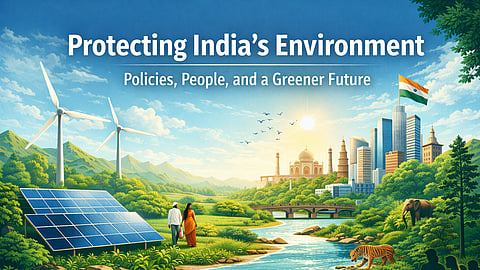
Protecting the Planet, Powering the Future: India’s Expanding Push for Environmental Protection

India’s environmental challenge is unlike any other. Home to nearly one-fifth of humanity, the country must balance rapid economic growth with ecological responsibility.
Over the past decade, environmental protection in India has evolved from fragmented interventions into a multi-layered national mission—combining government initiatives, community participation, and innovation at scale.
While the road ahead remains complex, India’s approach reflects a growing recognition that environmental protection is not a constraint on development, but a prerequisite for sustainable prosperity.
A Policy Framework Anchored in Sustainability
Environmental protection in India is guided by a strong constitutional and legal foundation. Article 48A of the Constitution directs the State to protect and improve the environment, while Article 51A places a duty on citizens to safeguard natural resources.
Building on this framework, the government has launched flagship initiatives that integrate climate action with economic planning:
National Action Plan on Climate Change (NAPCC) with missions on solar energy, water, sustainable agriculture, and Himalayan ecosystems
Long-Term Low Emissions Development Strategy, aligning climate goals with growth priorities
Updated Nationally Determined Contributions (NDCs) under the Paris Agreement
These policies signal India’s intent to decouple growth from environmental degradation.
Clean Energy at Scale: The Renewable Revolution
One of India’s most visible environmental successes lies in renewable energy expansion.
Through initiatives such as the National Solar Mission, India has rapidly increased solar and wind capacity, emerging as one of the world’s leading renewable energy markets. Large solar parks, rooftop solar programmes, and hybrid renewable projects are reducing dependence on fossil fuels while creating jobs and attracting global investment.
India’s push for green hydrogen, energy storage, and electric mobility further strengthens its clean energy ecosystem—critical for lowering emissions in transport and industry.
Cleaning Rivers, Restoring Ecosystems
Rivers are lifelines for India’s ecology and culture. Programmes like Namami Gange have focused on pollution abatement, sewage treatment, and riverfront rejuvenation, combining infrastructure upgrades with public participation.
Beyond rivers, ecosystem restoration efforts are gaining momentum:
National Afforestation Programme to expand green cover
Mangrove and coastal restoration to protect biodiversity and climate resilience
Wetland conservation initiatives safeguarding critical habitats
These efforts recognise that environmental protection must extend beyond cities into forests, coasts, and rural landscapes.
Waste Management and the Move Toward Circularity
India’s urbanisation has brought waste challenges to the forefront. The government has responded with reforms aimed at reducing landfill dependence and promoting resource efficiency.
Key initiatives include:
Swachh Bharat Mission, transforming sanitation and solid waste management
Plastic Waste Management Rules, promoting extended producer responsibility
Waste-to-energy and composting projects, converting waste into value
Together, these measures are nudging India toward a more circular economic model, where waste is minimised and materials are reused.
Protecting Biodiversity and Wildlife
India is one of the world’s most biodiverse countries, home to iconic species and fragile ecosystems. Conservation programmes such as Project Tiger, Project Elephant, and Project Dolphin have strengthened habitat protection and species recovery.
India’s expanding network of national parks, wildlife sanctuaries, and biosphere reserves reflects a long-term commitment to biodiversity protection—supported by community involvement and technology-driven monitoring.
Citizen-Led Environmental Action
Perhaps India’s greatest environmental strength lies in its people.
From mass tree-plantation drives and cleanliness campaigns to water conservation and renewable adoption at the household level, citizen participation has become a defining feature of India’s environmental movement. Digital platforms, environmental education, and youth-led climate action are further amplifying impact.
Environmental protection in India is increasingly a shared responsibility, not just a government mandate.
Challenges Ahead, Momentum Intact
Despite significant progress, challenges persist—air pollution, water stress, climate vulnerability, and enforcement gaps remain pressing concerns. Addressing them will require stronger coordination, data-driven governance, and sustained investment.
Yet, India’s environmental journey is marked by scale, ambition, and adaptability. The country is demonstrating that development and environmental protection need not be opposing goals.
A Defining Decade for India’s Environment
As India moves through a decisive decade for climate and sustainability, its environmental initiatives offer a powerful message: protecting nature is central to national progress.
By combining policy reform, innovation, and citizen engagement, India is laying the foundation for a future where economic growth, social well-being, and environmental protection advance together—not apart.
