
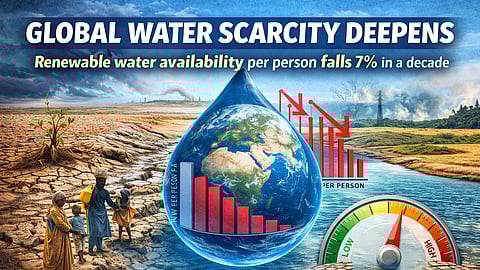
Renewable Water Availability per Person Falls 7% in a Decade as Global Water Stress Intensifies: FAO
Renewable freshwater availability per person has dropped by a further 7 percent over the past decade, deepening concerns over global water scarcity, according to the 2025 AQUASTAT Water Data Snapshot released by the Food and Agriculture Organization of the United Nations (FAO).
The latest update offers a comprehensive picture of how water availability and use are changing worldwide, drawing on data from the 2024 AQUASTAT reporting cycle. It tracks trends in irrigation, water-use efficiency and water stress, focusing on renewable freshwater—resources naturally replenished through the hydrological cycle of evaporation, precipitation and runoff.
Scarcity deepens in already stressed regions
The data shows that pressure on freshwater resources is intensifying, particularly in regions that already face severe constraints. Northern Africa and Western Asia continue to rank among the most water-scarce regions globally, with countries such as Kuwait and Qatar recording some of the lowest levels of renewable water availability per person.
At the same time, freshwater withdrawals have increased in several regions, further straining rivers, lakes and aquifers. Agriculture remains the dominant consumer of water worldwide, accounting for around 72 percent of total withdrawals in many regions.
Regional contrasts, shared challenges
The Snapshot highlights stark regional differences in both availability and use. In Northern Africa, per-capita freshwater availability remains critically low, while withdrawals have risen by 16 percent over the past 10 years. In Western Asia, rapid population growth combined with expanding agricultural demand is intensifying competition for already limited supplies.
Even regions with comparatively higher water endowments are not immune. Urbanization, industrial growth and the expansion of irrigated agriculture are driving increased competition among sectors, underscoring that abundance does not guarantee security.
Irrigation gaps and efficiency gains
The data also points to uneven progress in irrigation and water-use efficiency. In parts of Latin America and Asia, irrigation underpins a large share of crop production. By contrast, in Sub-Saharan Africa, irrigated land accounts for only a small fraction of total cultivated area, reflecting ongoing gaps in infrastructure and access to reliable water.
While several regions have recorded improvements in water-use efficiency, water stress levels remain high—or very high—in countries where withdrawals consistently approach or exceed renewable supplies.
SDG 6.4: Progress with pressure
The Snapshot updates the two indicators used to monitor Sustainable Development Goal 6.4, which tracks water-use efficiency and water stress. Although efficiency gains are evident at a global level, FAO cautions that persistently high stress levels highlight the urgent need for stronger, more sustainable water management and greater resilience as demand continues to grow.
As climate change, population growth and food security concerns converge, the AQUASTAT findings send a clear signal: managing freshwater wisely is becoming one of the defining challenges of the decade ahead.
