
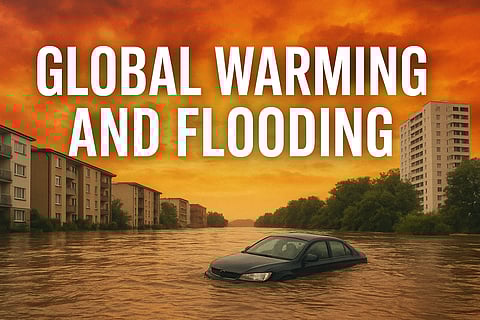
Rising Waters, Rising Alarms: How Global Warming Is Reshaping the World’s Flood Future

As the planet heats up at an unprecedented pace, one of the most visible and devastating consequences is unfolding in real time: the escalation of global flooding.
From swollen rivers in Europe to relentless monsoon extremes in Asia and rapid ice melt in the Arctic, global warming is transforming water from a source of life into a growing force of destruction.
Pakistan Floods: 9 Million More Risk Being Pushed into Poverty
Heat That Fuels the Deluge
The science is straightforward yet alarming. Warmer temperatures lead to increased evaporation, and a warmer atmosphere holds more moisture—about 7% more water vapour for every 1°C rise. This means heavier downpours, more intense storms, and rainfall patterns that are increasingly erratic.
At the same time, glaciers and ice sheets are melting at record rates. Sea levels, rising steadily for decades, now threaten low-lying nations, coastal metros, and millions living near shorelines. In many regions, high tides that were once rare have become almost routine.
Floods That Redraw Maps and Lives
In the past few years alone, floods have caused unprecedented devastation across continents:
Europe’s flash floods have overrun riverbanks, submerging towns that were unprepared for such extremes.
South Asian monsoon surges have left millions displaced, with urban flooding becoming an annual crisis for cities like Mumbai and Dhaka.
Africa’s cyclonic rains have triggered humanitarian emergencies, washing away farmlands and worsening food insecurity.
The U.S. East Coast and Gulf states are witnessing “sunny day floods” as rising seas push water into city streets even without storms.
Each event may feel local, but the root cause is deeply global.
Cities on the Climate Frontline
Urban centres are especially vulnerable. Unplanned development, poor drainage, clogged waterways, and the loss of wetlands amplify the impact of heavy rainfall. Concrete-heavy cities heat up faster, intensifying local atmospheric changes and contributing to more extreme precipitation.
The economic toll is staggering—damaged infrastructure, halted businesses, health crises, and rising insurance costs. But the humanitarian toll is even greater: the loss of homes, livelihoods, and sometimes entire communities.
Adaptation: The Race Against Time
The world is waking up to the need for flood-resilient planning. Nations are investing in:
Nature-based solutions such as restoring mangroves, wetlands, and river floodplains
Smarter infrastructure, including improved drainage systems and urban green spaces
Early warning systems and data-driven forecasting
Policies limiting construction in high-risk zones
But adaptation alone is not enough. Without a significant reduction in global emissions, the scale of future flooding could surpass even the worst-case projections.
A Planetary Wake-Up Call
Global warming is not a distant threat—it is a lived experience for millions dealing with rising waters. The floods reshaping coastlines and sweeping through cities are reminders that climate change is unfolding now, not in some imagined future.
The choices governments, businesses, and individuals make today will determine whether the next generation inherits a planet defined by crisis or resilience.
