
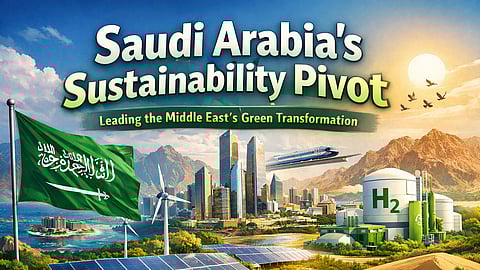
Saudi Arabia’s Sustainability Pivot: How the Kingdom Is Redrawing the Middle East’s Green Future

Saudi Arabia has long been synonymous with oil wealth. Yet over the past few years, the Kingdom has begun repositioning itself—not as the region’s biggest emitter, but as potentially one of the Middle East’s strongest sustainability champions.
This transformation isn’t cosmetic. Rather, it reflects a calculated national strategy to safeguard economic resilience, attract green financing, and pivot toward a post-hydrocarbon future while securing leadership in the global climate transition.
From Pumping Oil to Seeding Green Economies
Saudi Arabia’s Vision 2030 laid the foundation for rethinking growth beyond fossil fuels. Sustainability is no longer framed merely as an emissions issue but as a national security imperative:
Protect water resources in one of the world’s driest regions
Reduce dependency on oil revenues
Ensure energy affordability and stability as global markets shift
This holistic framing differentiates the Kingdom from many neighboring states that still view decarbonization through the narrow lens of climate diplomacy.
Mega Projects Reimagined Through a Green Lens
Saudi Arabia’s futuristic giga-projects—NEOM, the Red Sea Project, Diriyah—serve as global showcases for green standards in planning and construction.
Key sustainability features include:
100% renewable energy targets for NEOM
Regenerative tourism models aimed at net-positive biodiversity impact
Circular economy approaches using smart waste and water systems
These commitments are not without skepticism, but they signal a willingness to test green innovations at scale—something few nations in the region have attempted.
Hydrogen Ambitions: Playing Off Oil Expertise to Dominate Tomorrow’s Fuel
Saudi Arabia is leveraging its petrochemical infrastructure to position itself as a global leader in green and blue hydrogen exports.
By aligning hydrogen growth with global decarbonization demand, Riyadh aims to ensure relevance in a world where oil demand declines. No other Middle Eastern country has articulated such a comprehensive hydrogen export vision backed by long-term investment and logistics.
Local Action: Building a Domestic Sustainability Culture
Beyond mega-projects, the Saudi Green Initiative and Middle East Green Initiative offer measurable commitments:
planting billions of trees
increasing renewable share in the national energy mix
improving carbon capture and storage capacity
implementing stricter air and waste management policies
The initiatives encourage private sector alignment and push local industries—cement, steel, petrochemicals—to decarbonize ahead of global pressure.
Geopolitical Edge: Sustainability as Influence
Rather than presenting sustainability as an obligation, Saudi Arabia is weaponizing it as soft power.
attracting global climate investment
leading regional green cooperation and diplomacy
reshaping global perceptions of Gulf states
This rebranding strengthens Saudi Arabia’s positioning as a modern, open, and future-oriented nation—particularly important for foreign investment diversification.
Challenges Remain
Skeptics argue that Saudi Arabia’s sustainability shift is a strategic hedge rather than a moral pivot. Key issues:
continued expansion of oil production capacity
scale and feasibility of giga-project sustainability claims
transparency in emissions reporting
However, even critics acknowledge that the scale of climate challenges demands experimentation, and Saudi Arabia is experimenting at unprecedented scale.
Conclusion: A New Green Power Center in the Making
Saudi Arabia’s sustainability journey is still in early chapters, but the narrative has changed dramatically. The nation once viewed solely as an oil giant is emerging as one of the most ambitious architects of a green Middle East.
If Saudi Arabia succeeds, it will redefine climate leadership in the Arab world—and prove that the transition from hydrocarbons to green economies is not only achievable, but can unlock new forms of wealth and geopolitical influence.
