
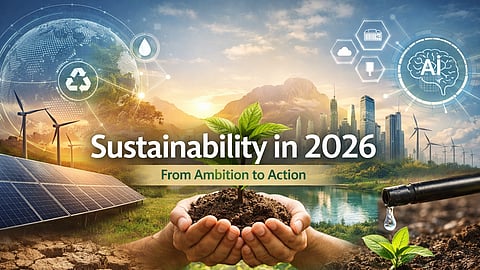
Sustainability and the Environment in 2026: From Promises to Proof

By 2026, sustainability is no longer a side conversation—it is the main storyline shaping economies, policies, businesses and everyday life. The world has moved past asking why sustainability matters. The more urgent question now is how fast meaningful change can happen, and who is willing to lead it.
From Climate Pledges to Climate Performance
The last decade was defined by ambitious climate pledges. In 2026, scrutiny has intensified. Governments, corporations and institutions are increasingly judged not by net-zero announcements, but by measurable emissions reductions, transparent reporting and credible transition plans. Greenwashing is facing sharper pushback, while data-driven accountability—powered by digital tools and AI—is becoming the new standard.
Carbon markets, once fragmented and opaque, are gradually maturing. Companies are being forced to prioritise real decarbonisation over offsets alone, especially as regulators and investors demand clearer climate disclosures and science-based targets.
Technology as a Sustainability Accelerator
Technology has emerged as one of the strongest enablers of environmental progress. Artificial intelligence, satellite monitoring and advanced analytics are transforming how we manage energy, water, agriculture and waste. In 2026, AI-driven forecasting helps utilities optimise water use, smart grids balance renewable energy loads in real time, and precision agriculture reduces resource waste while improving yields.
Yet technology is no silver bullet. Its success depends on ethical deployment, inclusive access and alignment with real-world environmental outcomes—not just efficiency gains.
Energy Transition Gains Momentum—but Unevenly
Renewable energy continues its rapid expansion, with solar and wind now firmly embedded as mainstream power sources. Energy storage, green hydrogen and grid modernisation are closing critical gaps, helping renewables move from intermittent to reliable.
However, the transition remains uneven. Developing economies still face financing challenges, infrastructure gaps and energy security concerns. In 2026, global cooperation—not competition—has become essential to ensure the transition does not deepen inequality.
Water, Biodiversity and the Forgotten Crises
While climate dominates headlines, water stress and biodiversity loss are emerging as equally urgent crises. Urban water scarcity, groundwater depletion and ecosystem degradation are directly affecting food security, health and economic stability.
Encouragingly, 2026 has seen growing investment in nature-based solutions—wetland restoration, mangrove protection and regenerative agriculture—recognising that environmental resilience and climate resilience are inseparable.
The Rise of Sustainable Consumers and Employees
Public awareness has matured. Consumers are more informed, sceptical and values-driven, while employees increasingly expect organisations to demonstrate genuine environmental responsibility. Sustainability is now a talent, trust and brand issue—not just a compliance exercise.
Companies that embed sustainability into core strategy, governance and culture are finding long-term resilience. Those that treat it as a marketing add-on risk reputational and financial fallout.
What 2026 Demands
Sustainability in 2026 is about execution. It demands collaboration across borders, sectors and disciplines. It calls for bold leadership, honest reporting and solutions that balance environmental protection with economic and social realities.
The path ahead is complex, but the direction is clear. The choices made today—on energy, water, nature and innovation—will define not just environmental outcomes, but the quality of life for generations to come.
In 2026, sustainability is no longer about imagining a better future. It is about building it—decisively, inclusively and without delay.
