
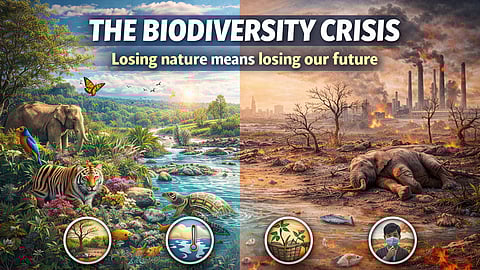
The Biodiversity Crisis: How the Loss of Nature Is Undermining the Environment—and Our Future

The planet is facing a biodiversity crisis of unprecedented scale. Across land, oceans and freshwater systems, species are disappearing at rates not seen for millions of years. This silent erosion of life is not just a conservation issue—it is an environmental emergency that is reshaping ecosystems, weakening climate resilience and threatening human well-being.
Biodiversity, the variety of life on Earth, underpins the natural systems that make the planet habitable. As it declines, the consequences ripple far beyond the loss of individual species, destabilising the environment in ways that are increasingly difficult to reverse.
A rapid and accelerating loss
Scientific assessments show that around one million species are at risk of extinction, many within decades. Habitat destruction, climate change, pollution, overexploitation of natural resources and invasive species are driving this decline simultaneously, creating a perfect storm for ecosystems already under stress.
Forests are being cleared faster than they can regenerate, wetlands are shrinking, coral reefs are bleaching, and grasslands are degrading. Each loss chips away at the intricate web of life that keeps ecosystems functioning.
Ecosystems under strain
Healthy ecosystems rely on biodiversity to remain productive and resilient. When species disappear, ecological balance is disrupted. Pollinators decline, soils lose fertility, water cycles become erratic, and food webs weaken.
For example, the loss of insects and birds reduces pollination, directly affecting food production. The decline of predators allows certain species to overpopulate, damaging vegetation and accelerating land degradation. In oceans, reduced biodiversity makes marine ecosystems more vulnerable to warming waters and acidification.
Climate change and biodiversity: a dangerous feedback loop
The biodiversity crisis and climate change are deeply interconnected. Climate change accelerates species loss through rising temperatures, extreme weather and shifting habitats. At the same time, declining biodiversity weakens nature’s ability to absorb carbon and regulate climate.
Forests, mangroves, peatlands and seagrasses are among the planet’s most powerful natural carbon sinks. When these ecosystems are degraded or destroyed, stored carbon is released back into the atmosphere, intensifying global warming and further stressing wildlife and habitats.
Impacts on food, water and human health
The environmental consequences of biodiversity loss directly affect human survival. Agriculture depends on healthy soils, pollinators and genetic diversity in crops and livestock. Fisheries rely on balanced marine ecosystems. Clean water is filtered by forests, wetlands and healthy river systems.
As biodiversity declines, food systems become more fragile, water quality deteriorates and the risk of zoonotic diseases increases. The loss of natural buffers also exposes communities to floods, droughts and storms, particularly in vulnerable regions.
An economic and social cost
Nature’s services to humanity—often called ecosystem services—are valued in trillions of dollars each year. The degradation of biodiversity represents a massive economic loss, affecting livelihoods, tourism, agriculture and public health.
Indigenous peoples and local communities, who often depend most directly on nature, are disproportionately affected. Yet they are also among the strongest stewards of biodiversity, highlighting the importance of inclusive, community-led conservation.
A narrowing window for action
The biodiversity crisis is not inevitable. Protecting and restoring ecosystems, reducing pollution, transitioning to sustainable agriculture and fisheries, and integrating biodiversity into economic and development planning can slow and even reverse nature loss.
Global frameworks such as the Kunming-Montreal Global Biodiversity Framework aim to protect 30 percent of land and oceans by 2030, restore degraded ecosystems and redirect harmful subsidies. But success depends on urgent, coordinated action by governments, businesses and individuals.
Rebuilding our relationship with nature
At its core, the biodiversity crisis reflects a broken relationship between humanity and the natural world. Reversing it requires recognising that environmental health, economic stability and human well-being are inseparable.
Protecting biodiversity is not about saving nature for its own sake alone—it is about safeguarding the life-support systems that sustain societies and future generations. The choices made today will determine whether the planet remains rich in life or enters an era of irreversible ecological decline.
