
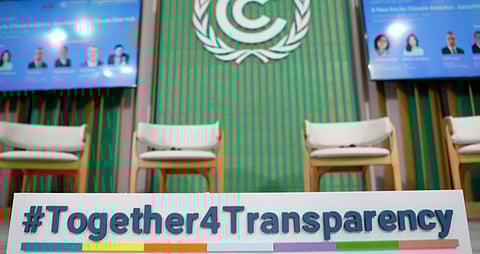
Transparency Takes Center Stage: How Paris Agreement Data Systems Are Re-shaping Global Climate Action
2025 will be remembered as the year transparency under the Paris Agreement moved from policy aspiration to operational reality. With the first cycle of the Enhanced Transparency Framework (ETF) completed, countries submitted their inaugural Biennial Transparency Reports (BTRs), followed by technical expert reviews and multilateral progress discussions.
For the first time, global climate action is grounded in systematic reporting, verified data and shared understanding—positioning transparency as a core driver of implementation rather than a bureaucratic exercise.
This shift elevates data, governance and accountability into the heart of climate ambition.
Transparency as a Catalyst for Climate Implementation
Completion of the First Transparency Cycle
The first ETF cycle signalled meaningful progress:
120 BTR submissions
strengthened institutional systems for tracking emissions
enhanced adaptation planning
financial mobilization for resilience and clean energy transitions
The inaugural BTR Synthesis Report confirmed that nations submitting reports are taking concrete steps to meet climate commitments—establishing the foundations for long-term net-zero pathways.
Diplomatic Momentum and Multilateral Trust
At the Global Transparency Forum and COP30’s High-Level Dialogue, ministers reinforced transparency as the backbone of global cooperation.
With transparency embedded in ministerial discourse—not just technical circles—the Paris Agreement’s legitimacy is strengthening.
Institutional Support Deepens for Developing Countries
Continuity for the Consultative Group of Experts
Countries agreed to extend the CGE indefinitely, ensuring stable and long-term support for nations preparing national communications and BTRs.
This decision anchors capacity-building at the core of the transparency agenda.
South–South Collaboration Expands
A Letter of Intent between UN Climate Change and China’s Ministry of Ecology and Environment commits to strengthening transparency systems through training, technology transfer, and institutional cooperation—particularly for developing nations.
Technological Innovation Driving Climate Data Systems
Launch of the Climate Data Hub
At COP30, the Climate Data Hub was launched in partnership with Microsoft, EY and NEDAMCO Africa. The platform consolidates Convention-related data into one accessible space, enabling:
easier tracking of national efforts
verification of progress
more informed policy and investment decisions
Reimagining NAZCA for the Data Age
The redesigned NAZCA platform will integrate mitigation, adaptation and resilience actions from non-Party stakeholders into a unified, credible repository—reflecting the Paris Agreement’s whole-of-society ethos.
Transparency Strengthens Climate Finance Pathways
Collaborations under the UNFCCC—such as work with CDP and the Center for Clean Air Policy—show how transparency can help unlock public and private finance by:
reducing risk through credible data
linking corporate and subnational action to NDC goals
demonstrating measurable, traceable climate impacts
Case studies, including Panama’s National Climate Transparency Platform, illustrate that transparent governance enables better coordination between investors, governments and local communities.
Learning as a Permanent Feature of Climate Governance
The ETF’s first cycle is not a finish line—it marks the beginning of continuous review and improvement.
Technical reviews identify:
where countries succeeded
where guidance is needed
where institutional capacity requires investment
This cycle of learning strengthens policy credibility and supports more ambitious future targets.
Conclusion: Transparency is Becoming the Engine of Ambition
As implementation of the Paris Agreement accelerates, transparency is shifting from compliance requirement to strategic enabler.
Transparent, comparable and credible climate data make it possible to:
build trust among nations
mobilize finance at scale
track real-world progress
elevate ambition
and reinforce multilateralism when geopolitical conditions challenge cooperation.
With ETF systems now operational, digital reporting platforms emerging, and technical support expanding for developing countries, transparency is no longer a technical afterthought—it is the foundation for delivering climate action at the speed and scale demanded by a warming planet.
