
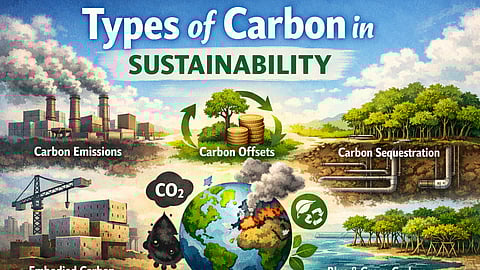
Understanding Types of Carbon in Sustainability: A Simple Guide

As global warming accelerates and nations scramble to meet climate goals, the language of “carbon” has entered everyday conversation. Yet, not all carbon is the same.
In climate science and sustainability planning, different types of carbon define how greenhouse gases are measured, reduced, or offset. Understanding these categories is crucial for industries, policymakers, and individuals working toward a low-carbon future.
1. Carbon Emissions (Carbon Footprint)
This refers to the total greenhouse gases—mainly CO₂—released into the atmosphere from:
burning fossil fuels
industrial processes
transportation
agriculture
electricity consumption
Why it matters:
Carbon emissions directly warm the planet. Sustainability efforts focus first on reducing emissions at source, through renewable energy, energy efficiency, electric mobility, and green manufacturing.
2. Carbon Intensity
Carbon intensity measures emissions per unit of output, such as:
CO₂ per kWh of electricity generated
CO₂ per km travelled
CO₂ per product manufactured
Why it matters:
Reducing intensity means producing more goods or services while emitting less—a key pathway for industries transitioning to clean technology without compromising growth.
3. Carbon Neutrality
Carbon neutrality means balancing emissions with removals, leading to overall net-zero emissions. Organizations achieve this by:
cutting direct emissions
choosing renewable power
investing in offsets (reforestation, carbon capture, conservation)
Why it matters:
Neutrality represents the bridge between high emissions today and future net-zero systems.
4. Carbon Offsets
These are activities or investments that remove or avoid emissions elsewhere, such as:
tree planting
soil carbon sequestration
renewable energy projects
methane capture
Why it matters:
Offsets compensate for unavoidable emissions, especially in hard-to-decarbonize sectors like aviation and heavy industry.
5. Carbon Sequestration and Storage
Carbon sequestration refers to capturing and storing carbon long-term to prevent it from entering the atmosphere. It happens through:
natural sinks: forests, oceans, soil
technological methods: carbon capture & storage (CCS)
Why it matters:
Sequestration is essential for reversing historical emissions and achieving long-term climate stabilization.
6. Embedded (Embodied) Carbon
Embodied carbon is the CO₂ emitted throughout a product’s lifecycle:
material extraction
manufacturing
transport
installation
disposal
Why it matters:
Buildings and infrastructure contain massive embodied emissions. Sustainable design focuses on low-carbon materials like bamboo, recycled steel, and green concrete.
7. Black Carbon
Black carbon consists of soot particles from incomplete combustion—diesel engines, open burning, biomass stoves.
Why it matters:
Though short-lived, black carbon traps heat far more effectively than CO₂ and contributes to glacial melting. Reducing it offers rapid climate benefits.
8. Blue, Green & Brown Carbon Resources
Nature-based climate solutions classify carbon ecosystems:
Green carbon – forests, grasslands
Blue carbon – mangroves, seagrass, wetlands
Brown carbon – carbon from biomass burning
Why it matters:
Protecting and restoring natural ecosystems enhances carbon sinks while preserving biodiversity and coastlines.
Why Understanding These Types Matters
Climate policies, carbon markets, ESG disclosures, and sustainability targets depend on the accurate accounting and reduction of emissions. Businesses are shifting toward:
verified reporting
net-zero roadmaps
nature-based climate solutions
circular production systems
Consumers too influence carbon futures through conscious choices and pressure for transparency.
The Road Ahead
To limit warming and ensure a livable future, global systems must transition:
from fossil fuels to renewables
from extraction to circularity
from offsetting to deep decarbonization
Understanding the types of carbon helps identify where change must begin—and how progress can be measured responsibly.
