
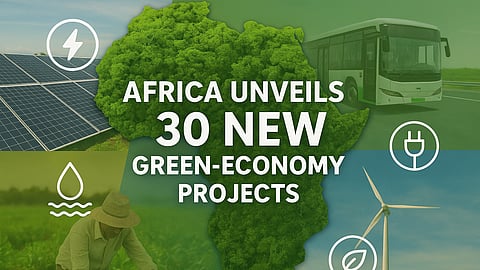
Africa Unveils 30 New Green-Economy Projects Ahead of Green Economy Summit 2026

In a major boost for the continent’s shift toward low-carbon growth, organisers of the upcoming Africa Green Economy Summit 2026 have unveiled a pipeline of nearly 30 investment-ready projects across clean energy, sustainable transport, water resilience, climate-smart agriculture and emerging climate technologies.
The announcement marks one of the most coordinated efforts yet to align Africa’s development priorities with the global climate finance landscape and to offer investors bankable, de-risked opportunities.
From Vision to Execution: Why this Pipeline Matters
The projects were selected from a wide pool of applicants after undergoing technical, commercial and environmental vetting. This curation process is significant because one of Africa’s long-standing challenges has been the shortage of investment-grade, finance-ready green projects.
CBI Invests in Boomitra to Advance Regenerative Agriculture Across the Middle East, Africa and Asia
By assembling a verified pipeline ahead of the summit, organisers are signalling a shift from broad climate commitments to the practical, transaction-focused work required to unlock capital.
A Diverse Mix of Clean Energy, Mobility and Climate Resilience
The project portfolio spans a wide array of sectors. Energy is a central component, with solar farms, hybrid wind-solar systems, and battery storage facilities designed to stabilise national grids and expand electricity access.
Mobility-focused projects include electric bus programmes, charging networks and clean transport corridors aimed at reducing fossil-fuel dependency in fast-growing cities. Water and resilience initiatives seek to modernise irrigation systems, improve water security and deploy renewable-powered desalination technologies.
Agriculture and land-use projects integrate regenerative farming, agroforestry and nature-based carbon models, while climate-tech innovations introduce digital platforms for analytics, early-warning systems and climate-risk management.
Investor Appeal: Readiness, Climate Impact and Bankable Design
A key strength of this pipeline is its emphasis on investment readiness. Each project comes with defined business models, measurable climate impact, and structures suitable for private capital, blended finance or public–private partnerships.
This significantly shortens investor due-diligence cycles and addresses common bottlenecks that slow climate finance deployment across Africa. The balanced mix of mitigation and adaptation projects also allows different investor types—from commercial lenders to philanthropies—to participate meaningfully.
Remaining Challenges on the Road to Implementation
Despite its promise, the pipeline’s success depends on tackling persistent barriers. Currency volatility, uneven regulatory environments and the need for enforceable long-term contracts continue to pose risks. Adaptation-focused projects, though urgently needed, often struggle to attract funding because their benefits do not always generate direct revenue.
Governments will need to ensure policy stability, while financiers expand blended finance instruments and guarantee mechanisms. Developers must also advance permitting, community engagement and environmental compliance to maintain project momentum.
Conclusion: A Turning Point for Africa’s Green Economic Future
Africa stands at a pivotal moment. The 30 investment-ready projects unveiled ahead of the Africa Green Economy Summit signal a shift from aspiration to action—showcasing a continent not only seeking climate finance but offering innovative, credible and scalable solutions.
If governments, investors and development partners build on this momentum, these projects could spark a new era of sustainable growth, delivering clean energy, secure water, modern transport and resilient agriculture for millions.
The pipeline is more than a collection of proposals; it is a blueprint for Africa’s green economic future and a testament to the continent’s growing capacity to lead in the global climate transition.
Read More: Africa’s Green Revolution: How the Continent Is Powering Growth Through Sustainability
