
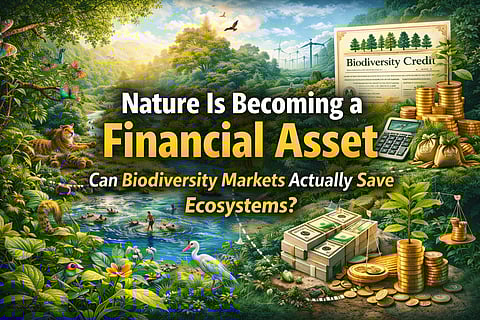
Nature Is Becoming a Financial Asset: Can Biodiversity Markets Actually Save Ecosystems?

The planet is facing an unprecedented biodiversity crisis. Species extinction rates are accelerating, ecosystems are degrading, and natural systems that sustain food, water, and climate stability are under immense strain. Yet conservation funding remains far below what is needed to halt this decline.
Into this gap steps a controversial idea: treating nature as a financial asset. Biodiversity credits, ecosystem service payments, and nature-based investment products are emerging as tools to channel private capital into conservation. Proponents argue these markets could unlock billions for nature protection. Critics warn they risk commodifying life itself.
The central question is unavoidable: Can biodiversity markets genuinely protect ecosystems—or do they simply repackage environmental loss in financial terms?
What Are Biodiversity Markets?
Turning Ecosystems Into Economic Value
Biodiversity markets assign measurable economic value to ecosystems, species, or ecological functions. In practice, this can include:
Biodiversity credits linked to habitat protection or restoration
Payments for ecosystem services such as water filtration or pollination
Corporate investments in nature-based solutions to meet sustainability or “nature-positive” commitments
These markets aim to make conservation financially competitive with activities like logging, mining, or agriculture—industries that historically drive ecosystem destruction.
Why Biodiversity Is Being Financialized
A Massive Funding Gap
According to global estimates, hundreds of billions of dollars per year are needed to halt biodiversity loss. Public funding alone is insufficient. As a result, policymakers increasingly look to private finance to help close the gap.
The United Nations has explicitly encouraged innovative financing mechanisms as part of the Kunming-Montreal Global Biodiversity Framework, which aims to protect 30% of land and sea by 2030.
Aligning Business With Nature
Supporters argue that markets can realign economic incentives. If nature has a clear price, destroying it becomes a financial loss rather than an externality. In theory, this could embed biodiversity protection into mainstream economic decision-making.
The Promise: How Markets Could Help Nature
Mobilizing Private Capital at Scale
Biodiversity markets could unlock investment flows far larger than government conservation budgets. Pension funds, corporations, and financial institutions are increasingly searching for credible nature-related investments.
Rewarding Stewardship
Well-designed markets can provide income to Indigenous communities, smallholders, and land managers who protect ecosystems—turning conservation into a viable livelihood rather than a charitable act.
Shifting Corporate Behavior
As companies face growing pressure to disclose and reduce their impacts on nature, biodiversity credits may offer a pathway to fund restoration and protection efforts that would otherwise go unfunded.
The Risks: Can Nature Really Be Priced?
Oversimplifying Complex Ecosystems
Ecosystems are not interchangeable. A restored wetland cannot truly replace an ancient forest, yet market mechanisms often rely on simplified metrics that treat biodiversity as fungible units.
This raises concerns that markets could legitimize destruction in one place as long as “compensation” occurs elsewhere.
Greenwashing and Weak Standards
Without robust governance, biodiversity markets risk becoming tools for greenwashing—allowing companies to claim “nature-positive” credentials without meaningfully reducing harm.
Poor monitoring, weak verification, and vague definitions of “biodiversity gains” could undermine ecological outcomes while protecting corporate reputations.
Ethical and Social Concerns
Critics argue that financializing nature may marginalize Indigenous peoples and local communities if land rights are unclear or if conservation projects restrict traditional livelihoods without fair consent or benefit-sharing.
The danger is replacing one form of exploitation with another—this time under a green financial banner.
Lessons From Carbon Markets
Biodiversity markets are often compared to carbon markets, which offer both cautionary and instructive lessons. While carbon pricing has mobilized finance, it has also suffered from credibility issues, uneven benefits, and questionable climate impact in some cases.
These experiences suggest biodiversity markets will only work if standards are strict, transparency is high, and ecological integrity is non-negotiable.
Can Biodiversity Markets Actually Save Ecosystems?
Markets Are Tools, Not Solutions
Biodiversity markets are neither saviors nor villains by default. They can help channel funding and shift incentives—but they cannot replace strong environmental regulation, land-use planning, or public investment.
Nature protection ultimately depends on limits, not just prices. Some ecosystems are too valuable, too irreplaceable, to be offset or traded.
The Path Forward: Guardrails for Nature Finance
For biodiversity markets to contribute meaningfully to conservation, several principles are essential:
Clear ecological baselines and science-based metrics
Strong governance, transparency, and independent verification
Respect for Indigenous rights and local participation
A hierarchy that prioritizes avoiding harm before offsetting it
Without these guardrails, markets risk normalizing loss rather than preventing it.
Conclusion: Pricing Nature Without Losing Its Value
Nature is entering the financial system because traditional approaches have failed to protect it at scale. Biodiversity markets reflect both urgency and experimentation in the face of ecological collapse.
They may help fund conservation—but they cannot substitute for political will, ethical responsibility, or ecological limits.
The real challenge is not whether nature has economic value—it clearly does. The challenge is ensuring that assigning a price to nature does not cause us to forget its pricelessness.
Saving ecosystems will require finance, yes—but also restraint, respect, and a willingness to protect nature simply because life depends on it.
