
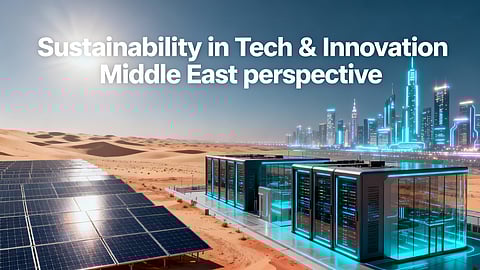
Insight — Sustainability in Technology & Innovation: A Middle East Perspective

The Middle East is often framed as an oil story; today it’s increasingly a story about scale — of solar deserts, industrial ambition, and fast-moving policy. Governments and private players across the Gulf and North Africa are not only decarbonizing power grids but are rethinking how technology, infrastructure and business models can be re-wired for long-term sustainability.
Aerzen Acquires GPE Turbo to Strengthen Its Edge as a Global Technology Pioneer
Below I unpack the trends, highlight fresh examples, and offer deeper thoughts on where technology and innovation must go next to make sustainability real — not just symbolic — across the region.
From megaprojects to everyday tech: an evolving palette of solutions
Large-scale renewables remain the headline: Abu Dhabi’s Masdar has moved from proving projects to building systems meant to deliver “uninterrupted” renewable baseload power — a US$6 billion initiative announced to provide 1 GW of steady clean energy and address reliability concerns as digital demand soars.
This kind of project signals the region’s intent to pair intermittency-solving technologies with vast solar resources.
Dubai’s Mohammed bin Rashid Al Maktoum Solar Park is another anchor: designed to grow to multi-gigawatt capacity by 2030 and steadily raise the share of clean power in the UAE mix. These are not vanity projects — they are grid-scale experiments in marrying affordability, scale and carbon reduction.
At the same time, distributed, business-facing models are scaling quickly. Companies like Yellow Door Energy have turned commercial rooftops, factories and microgrids into financed solar capacity across the Gulf and Africa, proving that sustainability can be productized for everyday enterprises.
Their 2024/25 commissioning cadence shows real commercial appetite for off-balance-sheet renewables.
Tech infrastructure: a new battleground for green gains
The region’s digital boom — cloud adoption, AI workloads, crypto experimentation, and data sovereignty — has produced a parallel need: greener data centers.
Consultants and operators now see the Middle East as uniquely positioned to build low-carbon digital infrastructure because of available land, direct solar resource, and forward looking national strategies.
That makes the region a potential exporter of “green compute” (data services matched to carbon-free energy) if policy, grid access and storage investments align.
For tech companies, this implies three priorities: (1) site data centers where carbon intensity is lowest and grid plans are transparent; (2) invest in energy flexibility (storage, demand response) and onsite renewables; (3) push for circularity in hardware lifecycle — procurement, reuse, and e-waste management — rather than repeating linear consumption models.
Hydrogen, batteries and the limits of hype: lessons in realism
Green hydrogen has been central to Gulf narratives of a fossil-fuel producers’ low-carbon pivot. NEOM’s green hydrogen initiative — ambitious in scale and symbolism — is an example of the region attempting to build globally relevant industrial decarbonization value chains.
Yet hydrogen brings hard technical, transport and economics questions; even major industrial players have restructured or exited expensive projects elsewhere, showing how fragile single-technology bets can be.
This underlines a core lesson: diversify the decarbonization toolbox and budget for iterative pilots, not one-off national monuments.
Circular innovation: beyond clean power to material & urban systems
Sustainability in tech is not only about electricity. The Middle East is starting to experiment with circular models — waste-to-sustainable aviation fuel (SAF), industrial symbiosis in logistics zones, and repurposing construction waste for modular building materials.
Abu Dhabi and other hubs are piloting waste-to-fuel and urban projects that treat waste as feedstock for energy and materials, which is where true decarbonization multiplies benefits (reduced landfill, lower embodied carbon, local jobs). These projects are nascent but pivotal for combining urban tech with industrial sustainability.
Policy & finance: the invisible scaffolding
Public policy — renewable targets, procurement models (IPP/PPA), soft financing and sovereign investment vehicles — is the region’s competitive advantage. Entities such as Masdar and national funds can take long views, de-risk early technologies and attract international capital.
The transition will accelerate where policy ties financing to measurable emissions reductions, grid integration plans and circular-economy rules that make second-life batteries and hardware recycling attractive economically.
What must change for tech sustainability to scale meaningfully
Match scale with operational rigor. Megaprojects attract headlines; the hard part is operations — balancing storage, grid stability and demand management. Climate-resilient operations (heat-tolerant PV, dust mitigation, water-smart cooling for data centers) must be engineered from day one.
Avoid monoculture technology bets. Hydrogen, CCS, solar, batteries — each has a role. The right path is a diverse portfolio that optimizes cost, timelines and lifecycle emissions. Realism about supply chains and modular pilots will reduce stranded assets.
Make industry circular by design. Incentivize refurbishing servers, reuse of EV and grid batteries, and industrial byproduct exchange (waste heat, materials). Policy can nudge OEMs and cloud providers into circular procurement.
Prioritise people and skills alongside megaprojects. Training, local supply chains and R&D hubs turn imported techno-optimism into sustainable local industry. Masdar and similar hubs are already moving in this direction; the next step is scaling labs that pair startups, universities, and industry.
Practical signposts for businesses and investors
Invest in verifiable carbon-matching or clean-energy procurement for cloud and compute contracts. Demand transparency in generators and PPAs.
Prioritise modular, upgradeable tech to avoid early obsolescence and e-waste — for hardware and energy systems.
Explore local PPAs and captive power where feasible; they lower cost and improve ESG credentials. Yellow Door Energy shows this model works at scale in the region.
Conclusion — from setting the table to serving the meal
The Middle East sits at an inflection point: it has the capital, the sun and the political will to rewrite large parts of the energy and industrial economy.
But achieving sustainability in tech requires moving beyond “big” to “smart” — aligning megaprojects with distributed solutions, policy with circular markets, and ambition with operational discipline.
If the region pairs its scale with pragmatic experimentation and transparent measurement, it can become a global testbed for sustainable tech that’s not only green on paper, but resilient, equitable and economically durable in practice.
Read More: ABB Opens AI and Digital Solutions Training Centre in UAE to Accelerate the Energy Transition
