
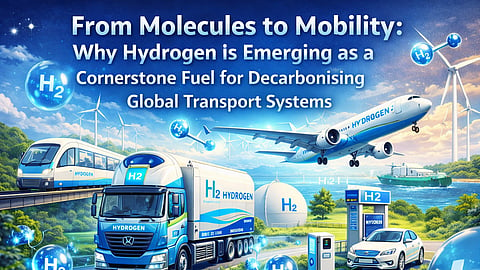
Insight: Why Hydrogen Is Emerging as a Cornerstone Fuel for Decarbonising Global Transport

Transport sits at the crossroads of economic growth and environmental stress. It enables global trade, mobility, and urbanization—but it also accounts for nearly a quarter of global energy-related carbon emissions.
While electrification is advancing rapidly, batteries alone may not be enough to decarbonize long-haul trucking, shipping, aviation, and heavy-duty transport.
This is where hydrogen enters the conversation—not as a silver bullet, but as a powerful complementary fuel capable of addressing the hardest-to-abate segments of transport.
What Makes Hydrogen Different?
Hydrogen is the most abundant element in the universe, yet it rarely exists freely on Earth. It must be produced from compounds such as water or hydrocarbons. When used as a fuel—either in fuel cells or through combustion—hydrogen’s only tailpipe emission is water vapor.
But hydrogen’s true value lies not just in its cleanliness at point of use, but in its versatility:
It can store large amounts of energy by weight
It enables fast refueling
It suits applications where batteries face limitations in weight, range, or downtime
In transport terms, hydrogen behaves more like a clean replacement for fossil fuels than a direct competitor to batteries.
Green, Blue, Grey: Why Hydrogen’s Color Matters
Not all hydrogen is created equal. Its sustainability depends entirely on how it is produced.
Grey Hydrogen: Produced from natural gas without capturing emissions—carbon-intensive and unsuitable for climate goals.
Blue Hydrogen: Made from natural gas with carbon capture and storage (CCS)—lower emissions, but still fossil-based.
Green Hydrogen: Produced by splitting water using renewable electricity—zero emissions, and the gold standard for sustainable transport.
For hydrogen to truly decarbonize transport, green hydrogen must dominate, supported by falling renewable energy costs and scaling electrolyser technologies.
Hydrogen in Road Transport: Heavy-Duty’s Best Bet
Battery electric vehicles work well for cars and short-distance travel. But for long-haul trucks, buses, mining vehicles, and freight corridors, hydrogen offers key advantages:
Ranges comparable to diesel
Refueling times of minutes, not hours
Lighter systems compared to large battery packs
Fuel cell electric vehicles (FCEVs) convert hydrogen into electricity onboard, offering quiet operation and zero emissions. Several countries are already piloting hydrogen truck corridors, especially where logistics reliability is critical.
Shipping and Aviation: Where Hydrogen Becomes Essential
Some sectors simply cannot rely on batteries.
Shipping
Hydrogen—often converted into derivatives like green ammonia or methanol—is emerging as a leading option for zero-emission maritime transport. These fuels are easier to store than pure hydrogen and compatible with existing engine designs with modifications.
For global shipping, hydrogen-derived fuels may be the only viable path to deep decarbonization.
Aviation
Direct hydrogen-powered aircraft are under development for short- and medium-haul routes. For long-haul flights, synthetic aviation fuels made using green hydrogen and captured CO₂ offer a scalable solution without overhauling aircraft fleets overnight.
Infrastructure: The Real Make-or-Break Factor
Hydrogen’s biggest challenge is not technology—it is infrastructure.
Producing, storing, transporting, and distributing hydrogen requires:
Electrolysers and renewable power
Pipelines or transport systems
Refueling stations
Safety standards and regulations
The good news: transport hubs, ports, airports, and freight depots are ideal early adopters. A hub-and-spoke approach, rather than nationwide rollout, can accelerate adoption while keeping costs manageable.
Sustainability Beyond Emissions
Hydrogen’s sustainability story goes deeper than carbon.
Energy security: Countries can produce hydrogen domestically from sun, wind, and water.
Industrial integration: Hydrogen can link transport with power, industry, and storage, creating system-wide efficiency.
Economic transition: It supports new industries, skilled jobs, and export opportunities—especially for renewable-rich regions.
When aligned with responsible water use, renewable energy expansion, and lifecycle planning, hydrogen strengthens—not strains—the sustainability equation.
The Future Outlook: From Niche to Necessity
Over the next decade, hydrogen is likely to follow a clear trajectory:
2025–2030: Pilots, corridors, and fleet-level adoption in trucks, buses, ports, and shipping
2030–2040: Cost parity with fossil fuels in heavy transport, driven by scale and policy support
Beyond 2040: Integration into global transport systems through hydrogen-based fuels and multi-modal hubs
Policy frameworks, carbon pricing, and international standards will determine the pace—but the direction is increasingly clear.
Conclusion: Hydrogen’s Role in a Realistic Net-Zero Path
Hydrogen will not replace batteries, nor should it try to. The future of clean transport is plural, pragmatic, and purpose-driven. Batteries will dominate light-duty mobility; hydrogen will decarbonize what batteries cannot.
As the world moves from ambition to execution on climate goals, hydrogen stands out as a fuel that aligns technology, sustainability, and scale. If produced cleanly and deployed wisely, hydrogen can help transport not just move people and goods—but move the planet closer to a net-zero future.
