
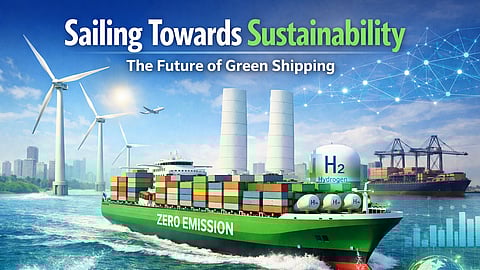
Sailing Towards Sustainability: The Future of Green Shipping

The shipping industry, responsible for moving over 80% of global trade, is under increasing scrutiny for its environmental footprint.
With the International Maritime Organization (IMO) targeting a 50% reduction in greenhouse gas (GHG) emissions by 2050, the future of shipping is steering toward cleaner fuels, smarter vessels, and innovative operational strategies. The urgency to decarbonize shipping is not just regulatory—it is a critical step toward global climate goals.
Clean Fuels: Powering Ships of Tomorrow
The transition from conventional heavy fuel oils to low- and zero-emission alternatives is gaining momentum. Liquefied natural gas (LNG), green ammonia, hydrogen, and biofuels are emerging as viable solutions.
While LNG serves as a transitional fuel reducing sulfur and CO₂ emissions, hydrogen and ammonia-powered ships promise near-zero carbon emissions, though challenges remain in storage, infrastructure, and cost.
Shipowners and energy providers are increasingly collaborating to develop fueling networks at major ports worldwide.
Digitalization and Smart Shipping
Green shipping is not just about alternative fuels—it also involves smarter operations. Artificial intelligence, real-time route optimization, and digital twins of vessels are helping shipping companies reduce fuel consumption and carbon output.
Predictive maintenance and energy-efficient propulsion systems further cut emissions, ensuring vessels operate at peak performance while minimizing environmental impact.
Regulatory Winds Driving Change
Global regulations are accelerating the green shipping transition. The IMO’s Energy Efficiency Existing Ship Index (EEXI) and Carbon Intensity Indicator (CII) are now mandatory benchmarks for operational efficiency, nudging shipowners to retrofit older vessels or invest in next-generation designs.
Regional initiatives, such as the European Union’s Emissions Trading System (EU ETS) for shipping, add financial incentives to accelerate decarbonization. Compliance with these regulations is no longer optional—it’s a strategic imperative.
Collaborative Innovations and the Blue Economy
Decarbonizing shipping is a collective effort. Public-private partnerships, research consortia, and cross-industry alliances are driving technological breakthroughs.
From floating wind-assisted propulsion systems to port electrification and carbon capture integration, innovation is reshaping the maritime landscape. Companies that embrace sustainable practices now are positioning themselves as leaders in the blue economy—a future where commerce and climate stewardship go hand in hand.
Outlook: Navigating Towards Net Zero
The path to a green maritime sector is challenging but achievable. Investment in clean fuels, digitalization, and regulatory compliance will define the next decade of shipping.
By combining innovation, collaboration, and commitment, the industry can chart a course toward net-zero emissions, ensuring that global trade remains both economically robust and environmentally responsible.
