
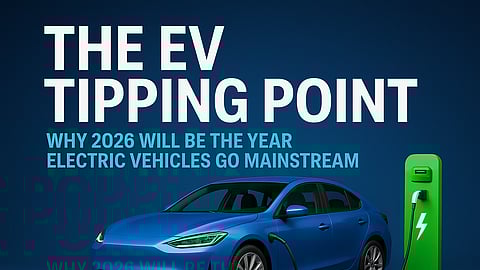
The EV Tipping Point: Why 2026 Will Be the Year Electric Vehicles Go Mainstream

For over a decade, electric vehicles (EVs) have been positioned as the future of mobility—promising cleaner roads, lower emissions, and a bold shift away from fossil fuels. But until recently, the transition has been gradual, shaped by concerns around charging access, battery life, and affordability.
Now, however, the global EV landscape is approaching a decisive moment. By 2026, the world is set to cross the EV tipping point, where electric vehicles move from niche adoption to becoming the preferred choice for millions of drivers.
1. Prices Are Finally Reaching Parity with Petrol Cars
The biggest barrier to EV adoption has always been cost. But industry forecasts show that by 2026, battery costs—the most expensive component of an EV—will fall to record lows. Combined with government incentives and improved manufacturing efficiencies, many EV models will be priced on par with, or even cheaper than, comparable petrol cars.
This affordability shift is expected to unlock a new wave of buyers, especially in developing markets where cost is key.
2. Game-Changing Battery Technology Will Reset Expectations
From next-generation lithium-ion batteries to the long-awaited solid-state breakthrough, energy density and charging speeds are improving faster than at any point in EV history.
By 2026, mainstream EVs could offer:
800–1,000 km range on a single charge
10–15 minute rapid charging
Longer battery lifespans with lower degradation
This leap in performance will effectively eliminate range anxiety, one of the biggest psychological barriers to EV adoption.
3. Charging Infrastructure Will Expand Faster Than Ever
Governments and private companies are investing billions into expanding charging networks worldwide. The result is a charging ecosystem that will look dramatically different by 2026.
Expect:
High-speed chargers on major highways
Ultra-fast charging hubs in cities
Widespread workplace and residential charging solutions
Solar-powered and battery-supported chargers in remote areas
For the first time, EV owners won’t need to “plan” their charging—they’ll simply charge wherever they go.
4. Automakers Are Going All-In on Electric
Global automakers—from legacy giants like Ford, GM, Toyota, and Volkswagen to new-age disruptors like Tesla, BYD, and Rivian—are announcing record investments in EV platforms. Many have set 2026–2030 as the turning point for shifting the majority of their product lines to electric.
This means:
More models
More price ranges
More competition
Better quality
Consumers will have unprecedented EV options across segments—from compact city cars to long-range SUVs and high-performance luxury models.
5. Policy Push: Governments Are Setting Hard Deadlines
Countries across Europe, Asia, and the Middle East are tightening emissions rules and offering financial incentives to encourage EV adoption. Key milestones are scheduled around 2025–2026, including stricter CO₂ standards, expanded tax credits, and bans on high-emission vehicles in major cities.
As regulation pushes in one direction and incentives pull in another, consumers will find buying an EV more attractive—and sometimes more economically sensible—than buying a petrol car.
6. The Cultural Shift: EVs Are Becoming Aspirational
Beyond the technology, the cultural perception of EVs is changing. Once viewed as experimental or elite, EVs are now symbols of smart ownership, environmental responsibility, and modern living. Influencers, celebrities, and even governments are embracing electric mobility as a lifestyle shift.
By 2026, EVs won’t just be a smart choice—they will be an expected choice.
The Road Ahead
As these factors converge—affordability, technology, infrastructure, competition, policy, and cultural acceptance—2026 is shaping up to be the breakout year when EVs truly go mainstream.
The transition won’t be without challenges: grid upgrades, battery recycling, and standardising charging networks remain critical. But the momentum is unstoppable.
The world is approaching an era where electric vehicles aren’t just another option—they are the default option.
The tipping point is near. And by 2026, the future of mobility will officially arrive.
