
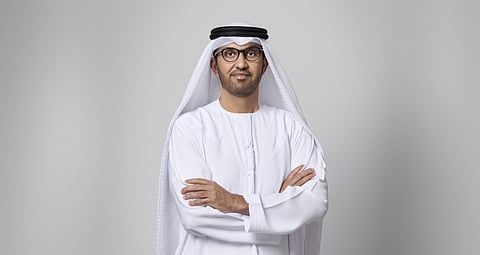
Weaponising Hormuz Is Economic Terrorism, Says Dr Sultan Al Jaber at CERAWeek
UAE Minister of Industry and Advanced Technology and ADNOC CEO Dr Sultan Ahmed Al Jaber issued a strong warning against attempts to disrupt the Strait of Hormuz, calling it “economic terrorism against every nation” with far-reaching global consequences.
Speaking at CERAWeek in Houston, Al Jaber underlined that any threat to the strategic waterway goes beyond regional tensions and directly impacts the global economy. He stressed that when Hormuz is squeezed, the ripple effects are felt worldwide—from factories and farms to households.
Highlighting the scale of the risk, he noted that nearly a fifth of the world’s oil and gas flows through the narrow passage, alongside significant shares of fertilizers, petrochemicals, and industrial metals. “Much of the oxygen of the global economy runs through a single artery,” he said, warning that disruption has already driven a sharp surge in oil prices, increasing the cost of living and slowing economic growth globally.
Al Jaber strongly criticised Iran, accusing it of launching an “illegal, unjustified and unprovoked” attack on the UAE and the wider region. He asserted that no country should be allowed to hold the global economy hostage, emphasizing that the current crisis is not about supply shortages but about security. “We cannot trade our way out of this. The only durable solution is to keep the Strait open,” he said.
He pointed to growing international support for stability, noting that a record number of countries have backed UNSC Resolution 2817, while 22 nations issued a joint statement condemning attacks on commercial vessels, civilian infrastructure, and energy facilities.
Describing the situation as a direct threat to global stability, Al Jaber reiterated that energy security is fundamental. “It is not a slogan—it is the difference between lights on and lights off,” he said, adding that stable energy markets underpin every sector of the global economy.
He revealed that ADNOC had faced unprecedented challenges amid the crisis. “We took hits that no civilian enterprise should ever have to deal with,” he said, while assuring that operations remain under control with full visibility and a methodical response in place to safeguard supply and personnel.
Al Jaber emphasized that the UAE’s resilience is built on long-term investment, strategic partnerships, and preparedness rather than reaction. He highlighted strong ties with the United States, noting that ADNOC, Masdar, and XRG have collectively invested over $85 billion in US energy assets, supporting infrastructure and jobs across multiple states.
Looking ahead, he drew a clear contrast between two global paths—one driven by instability and the other by prosperity. Reaffirming the UAE’s commitment to collaboration and progress, he invited global energy leaders to the upcoming ADIPEC 2026 in Abu Dhabi for discussions on strengthening the resilience of the global energy system.
“Stability does not happen by chance. It must be built collectively,” Al Jaber said, urging nations to stand with those who promote growth and cooperation over conflict.
