
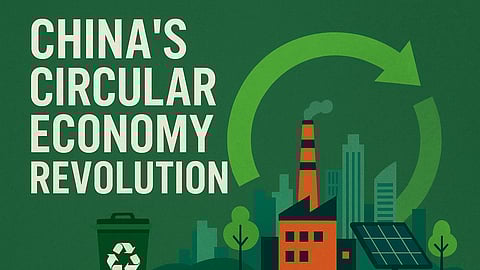
China’s Circular Economy Revolution: How the World’s Largest Manufacturing Hub Is Rebuilding for a Regenerative Future

China’s Quiet Green RevolutionChina, long known as the “factory of the world,” is undergoing a profound transformation. Faced with mounting waste, rising material costs, and climate pressures, the country is placing circularity at the heart of its economic strategy.
Through large-scale policy reforms, industrial redesign, and technology-driven waste recovery systems, China is accelerating its shift from a linear “produce–consume–discard” model to a regenerative economy.
Policy Power: Strong Frameworks Driving Rapid Adoption
China’s journey is powered by robust national policies. The Circular Economy Promotion Law and the 2021–2025 Five-Year Plan embed circularity across manufacturing, construction, energy, and urban planning.
China’s Quiet Green Revolution
This includes mandates for recycling infrastructure, eco-design standards, industrial symbiosis parks, and stricter waste-sorting regulations in major cities.
These frameworks create a unified direction: every product, process, and resource must aim for maximum reuse and minimum waste.
Industrial Symbiosis: Turning Waste Into Wealth
One of China’s most impactful innovations is the expansion of eco-industrial parks, where waste from one factory becomes a resource for another. Steel mills provide heat to nearby residential zones, chemical by-products feed new processes, and renewable energy integrates into manufacturing clusters.
This closed-loop system reduces emissions, lowers production costs, and demonstrates how circularity can scale across heavy industries.
Consumer Markets Embrace Circular Innovation
China’s rising middle class is also driving a cultural shift. Recommerce platforms for refurbished electronics, second-hand fashion, and rental models are booming. Mobile recycling units, AI-driven sorting machines, and digital waste-credit apps are making recycling accessible and rewarding.
This behavioural change is crucial to achieving national circularity goals.
Tech-Driven Waste Management for a Cleaner Future
Technology is at the core of China’s circular push. Smart bins with facial recognition in cities, blockchain-based tracking of recycled materials, and robotics-powered sorting facilities are improving recycling rates.
Meanwhile, investment in battery recycling and critical-minerals recovery is positioning China as a global leader in sustainable supply chains for EVs and electronics.
Global Implications: Setting New Standards for Circular Supply Chains
China’s progress has global ripple effects. As the world’s largest producer and exporter, China’s adoption of circular practices influences international manufacturing standards, promotes greener exports, and reshapes global resource flows.
Companies worldwide sourcing from China are required to meet higher sustainability expectations, driving international alignment on circular economy norms.
A Future Built on Regeneration
From industrial clusters to city neighborhoods, circularity in China is no longer a niche concept — it is becoming an economic pillar.
As the country integrates circular principles into energy, manufacturing, consumer markets, and logistics, it is building a regenerative system capable of sustaining growth while reducing environmental impact.
China’s circular economy momentum suggests a larger global shift: the future belongs to nations that design out waste, preserve resources, and build smarter, more sustainable industries.
Read More: Saudi Arabia Steps Up Climate Action: A Bold Path Toward a Greener Future
