
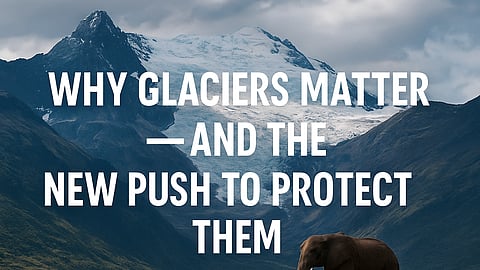
Why Glaciers Matter — And the Urgent Push to Protect Them
High in the mountains of Switzerland, Nepal, and Pakistan, the summer of 2024 delivered a stark warning. Avalanches roared down slopes, glacial lakes burst their banks, and flash floods swept through remote villages — destroying homes, roads, and lives.
Though thousands of kilometres apart, these disasters shared the same triggers: rapidly thawing permafrost and swelling glacial lakes pushed to the brink by a warming planet.
Scientists say such events are no longer freak occurrences. As global temperatures climb, glacial lake outburst floods threaten nearly 15 million people worldwide — a reminder that glaciers, Earth’s most fragile sentinels, are under siege.
Tajikistan’s Melting Glaciers put Water Resources under Stress, UNEP Atlas Reveals
A Planet Losing Its Ice Faster Than Ever
From the Andes to the Alps and the Himalayas, glaciers are retreating at alarming speed. For the third consecutive year, every major glacier region on Earth reported net loss, according to the World Meteorological Organization.
These ancient ice bodies hold 70% of the world’s freshwater, releasing it slowly through the year to sustain rivers, farms, hydropower systems, forests, wildlife — and more than 2 billion people. But rising temperatures are accelerating melt far beyond natural cycles.
Air pollution adds insult to injury. Soot, dust, and sand settle on bright ice surfaces, darkening them and reducing reflectivity. The result: faster melt, deeper warming, and thawing permafrost that releases trapped greenhouse gases — a dangerous feedback loop with global consequences.
The near-term impacts are severe: unstable glacier lakes, collapsing slopes, and unpredictable river flows. In the long term, melted ice means dwindling water supplies and rising seas. Entire ecosystems — from fish spawning grounds to unseen microbial worlds — face irreversible loss.
A Future Written by Today’s Choices
The decade ahead will determine how much ice survives.
At 1.5°C of warming, over half of the world’s glacier mass could remain.
At 2.7°C, only a quarter will be left.
Under current global policies, we are heading toward 2.8°C — a trajectory that has already erased all glaciers in Slovenia and Venezuela, and imperils iconic ice fields in Peru, Uganda, Indonesia, and the Himalayas. In the Hindu Kush Himalayas alone — lifeline to 2 billion people — just a quarter of the ice may remain if temperatures rise by 2°C.
East Africa: A Continent Losing Its Last Ice
Nowhere is the crisis more visible than in East Africa.
The continent’s last glaciers — on Mt. Kilimanjaro, Mt. Kenya, and the Rwenzori Mountains — are disappearing at some of the fastest rates on Earth.
By 2030, Mt. Kenya’s glaciers may vanish completely.
By 2040, Kilimanjaro could lose its ice cap.
Since 2000, East Africa’s glacier area has shrunk by over 300%, leaving just 1.36 square kilometres in 2022.
Communities already feel the consequences. The Ngare Ndare River, fed by Mt. Kenya’s glaciers, has dropped 30% in volume, reducing crop yields, milk production, and water access for more than 2 million people.
Communities Move to Adapt — With Help
As ice retreats, UNEP and partners are racing to boost resilience. Initiatives such as the Adaptation at Altitude Programme and the Mountains ADAPT Small Grants fund help mountain communities diversify livelihoods, restore forests and landscapes, protect water sources, and adopt climate-smart agriculture.
In 2025, a grant helped the Indigenous Yiaku community near Mt. Kenya improve food security through drought-hardy crops and better water systems — an example of how locally led solutions can strengthen survival in a changing climate.
A Global Call to Protect the Cryosphere
The world is waking up to the threat. At the upcoming UN Environment Assembly (UNEA-7) in Nairobi, Member States will discuss a new resolution focused on safeguarding glaciers and the broader cryosphere. This follows the UN’s decision to declare 2025 the International Year of Glaciers’ Preservation, with 21 March designated as World Day for Glaciers.
As UNEP’s Julian Blanc warns:
“Glaciers are an early warning system, and that alarm is sounding loud. When we lose glaciers, we lose water, food security, cultures — and the chance of a stable future.”
There is still time to save much of the world’s ice. But every fraction of a degree, every policy decision, and every year matters. The fate of glaciers — and the billions who depend on them — hangs in the balance.
Read More: Countdown Begins: UAE National Joins Landmark Antarctic Expedition for Climate Action
